In the world of photography, few cameras hold a status as legendary as the Nikon D700. Even in 2025, over a decade and a half since its release, photographers still wax poetic about its “magical” 12-megapixel sensor, its analog-like grain, and its robust build. But standing right next to it in the history books is its successor, the Nikon D800, a camera that completely changed the game with a staggering 36-megapixel resolution that challenged medium format cameras of its time.
I’ve been out in the field putting these two full-frame titans head-to-head. We aren’t just looking at specs sheets here; we are looking at real-world performance. Does the D700’s legendary color science actually exist, or is it nostalgia speaking? Is the D800’s resolution worth the extra storage space? Let’s dive deep into a comparison that proves you don’t need the latest mirrorless gear to take stunning photos in 2025.
On paper, this shouldn’t even be a fair fight. The Nikon D700 was released in 2008, sporting a modest 12MP sensor. The D800 arrived in 2012, tripling that count to 36MP. In the fast-moving tech world, four years is an eternity.
However, specs don’t tell the whole story. The D700 is often cited as having a “thicker” Color Filter Array (CFA), which theoretically allows for richer, more accurate color separation at the cost of some light gathering. The D800 represents the shift toward modern, high-resolution sensors where the CFA might be thinner to improve low-light performance. My goal today is to see if that technical theory translates to a visible difference in your images.
The “Magic Color” Test: Myth or Reality?
One of the most persistent arguments for keeping a D700 in 2025 is the color rendering. Many purists claim that CCD sensors (though the D700 is actually CMOS, it shares DNA with that era) and early CMOS sensors render skin tones and greens better than modern high-res sensors.
To test this, I set up a tripod overlooking a landscape filled with autumn tones—red barns, green grass, and yellow leaves. I tried to keep everything consistent: same lens, same settings, same lighting conditions.
Left: Nikon D700. Right: Nikon D800. At base ISO, the differences are surprisingly minimal.
Here is the truth that might hurt some feelings: The difference is negligible.
Straight out of camera, the D700 files tended to be slightly brighter and leaned a bit more towards red/magenta in the raw files. The D800 was a bit more neutral. However, after applying basic edits to match them in post-processing, they became virtually indistinguishable.
If there is a difference in the Color Filter Array, it isn’t manifesting as a “magic look” that you can’t replicate on the D800. With a slight tint adjustment and exposure tweak, the D800 files looked identical to the D700. In 2025, with advanced raw editors like Lightroom or Capture One, the “color science” argument holds less water than it did a decade ago. You can make the D800 look like the D700, but you get three times the resolution to work with.
Dynamic Range and Exposure Recovery
Where the age gap starts to show a little more is in dynamic range, though perhaps not as dramatically as you might expect given the age difference.
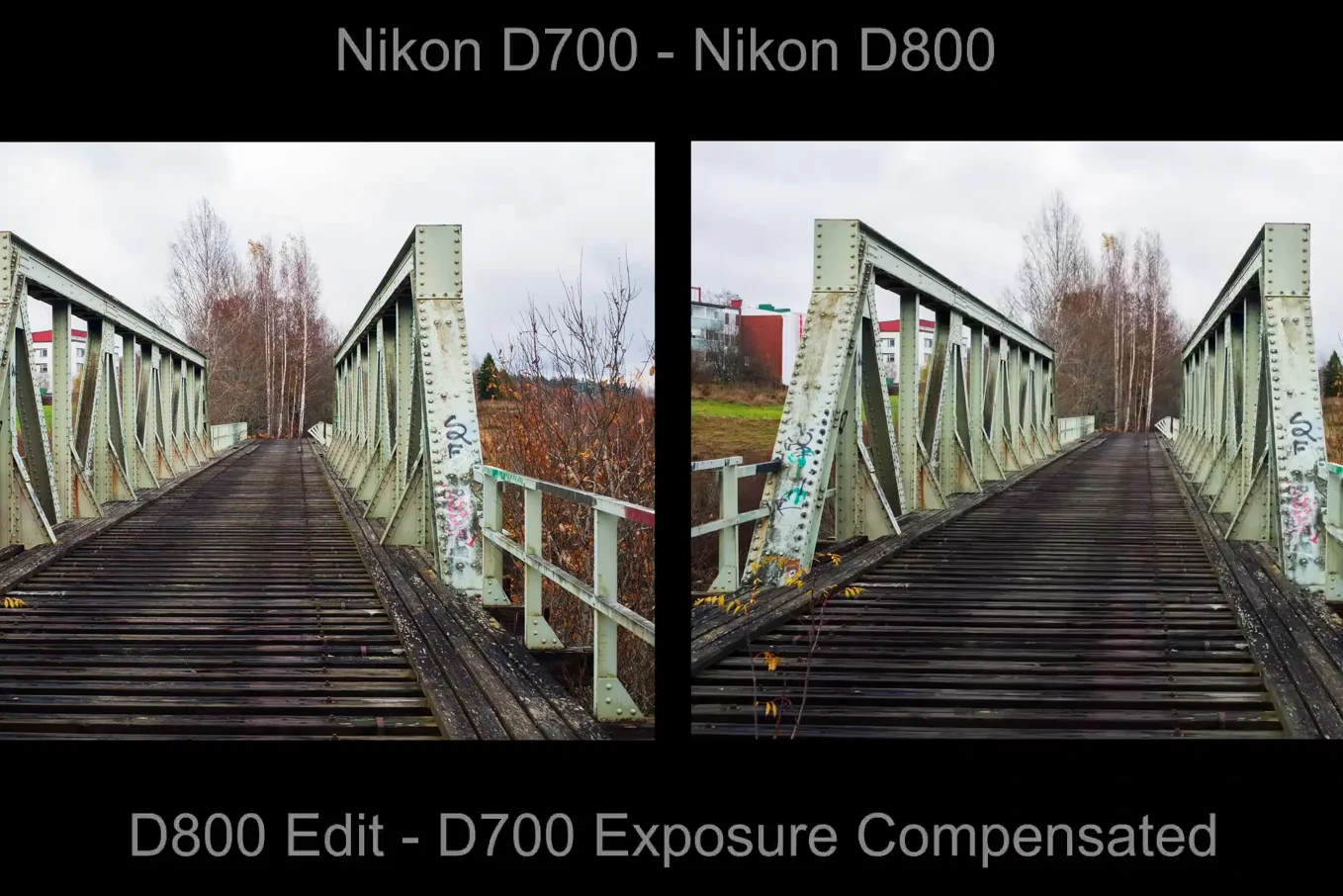
I shot a high-contrast scene under a bridge, looking out toward a bright overcast sky. This is a classic torture test for older sensors. Surprisingly, the D700 held its own.
Both cameras handle high-contrast daylight scenes competently, though the D800 has a slight edge in highlight retention.
In the edit, I noticed the D800 retains highlight information slightly better. When you pull back a blown-out sky, the D800 recovers smoothly, whereas the D700 clips a bit faster. However, in the shadows, the D700 is still a beast. The pixels are larger (since there are fewer of them on the same size sensor), which often helps per-pixel light gathering. But overall, for landscape photography in 2025, the D800 gives you a bit more safety net in your exposure.
Detail and Macro: The Resolution King
This is the category where the contest ends immediately. 12MP vs 36MP.
For social media (Instagram, Facebook), 12MP is plenty. In fact, it’s often preferred because the files are smaller and faster to process. But if you are shooting macro, landscapes, or portraits where you might want to crop in later, the D800 obliterates the D700.
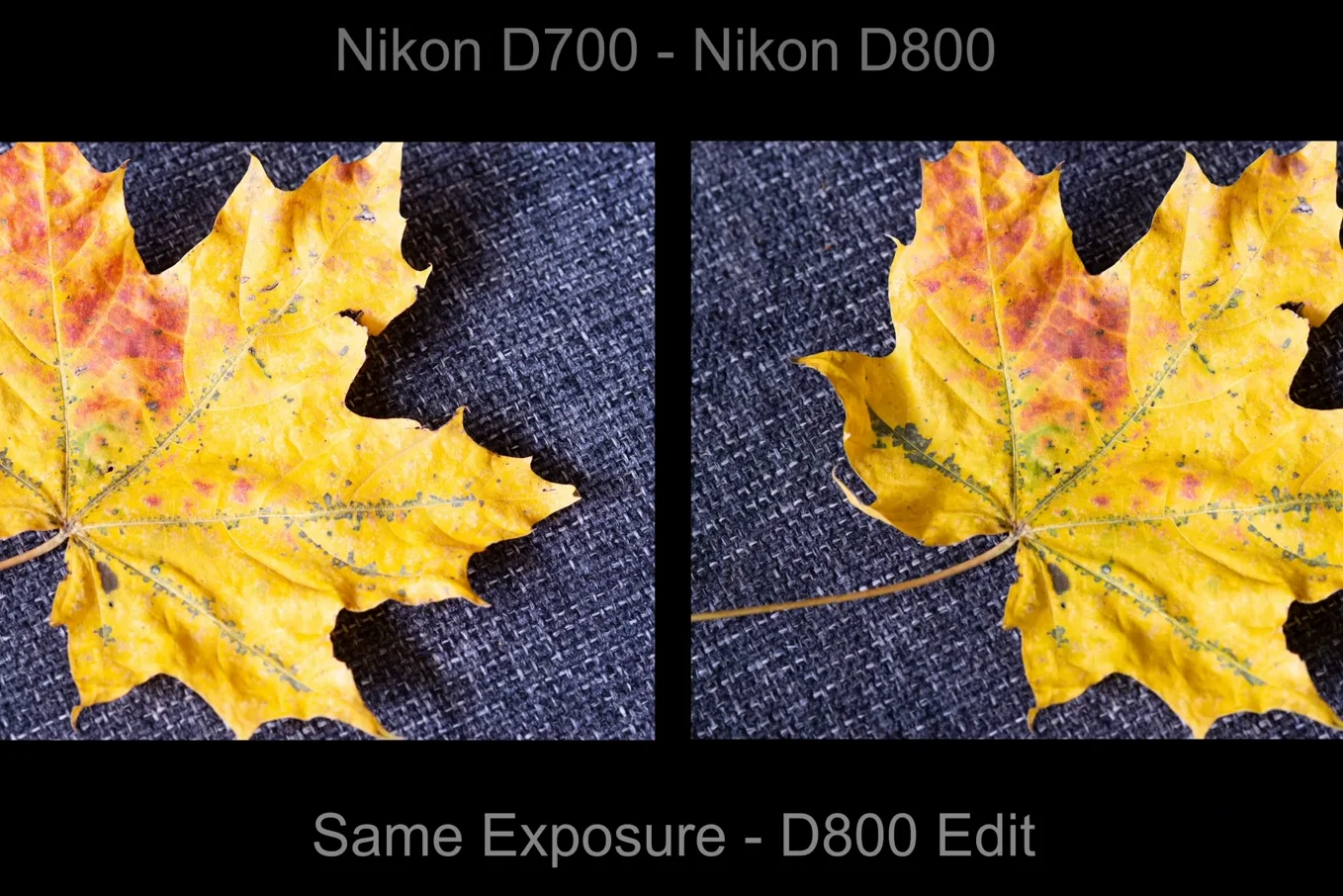
The macro capabilities are limited by the sensor resolution. The D800 captures incredibly fine veins in the leaf that the D700 softens.
When pixel-peeping a macro shot of a leaf, the difference is night and day. On the D800, you can zoom in and see the microscopic texture of the leaf structure. On the D700, that detail simply isn’t there—it’s pixelated blocks.
At 100% crop, the D800 (right) resolves texture that is completely lost on the D700 (left).
If you are a cropper—someone who likes to “fix” the composition in post—the D800 is your camera. With the D700, you need to get the composition right in-camera because you don’t have many pixels to spare.
The High ISO Torture Test: Subway Station
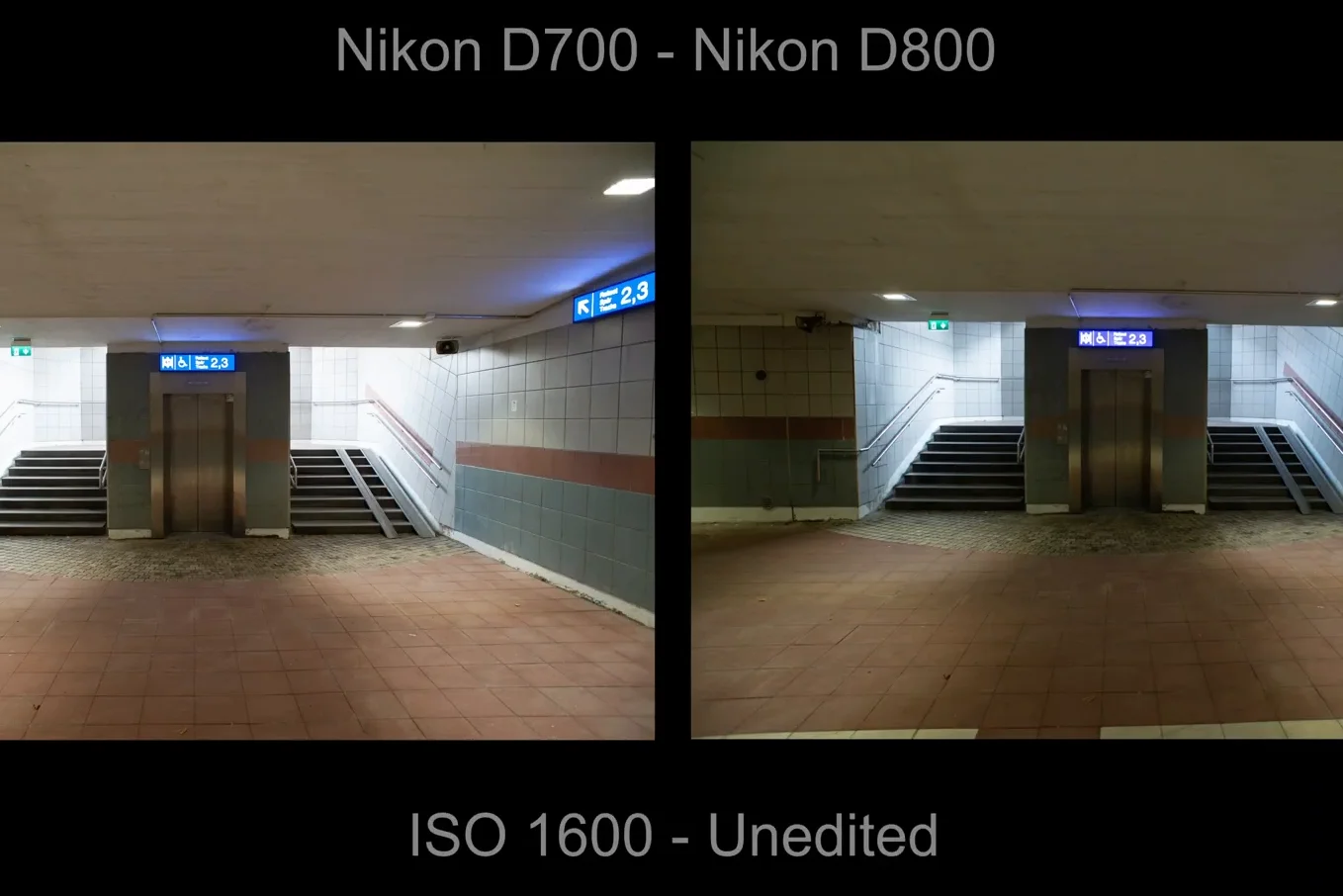
This was the most revealing part of my comparison. I took both cameras into a dimly lit subway station to test high ISO performance. This is where sensor technology improvements over four years really shine.
At ISO 1600, both cameras are very clean. The D700 was famous for its low-light capability in 2008, and it still looks great here.
At ISO 1600, both cameras produce clean, usable files. The D700 holds up remarkably well here.
However, when we push the limits to extreme ISOs (like 25,600—which is boosted on the D700), the D700 falls apart completely.
The noise on the D700 at extreme ISOs is “dirty.” It’s blotchy, with large clumps of color noise and, most distractingly, severe horizontal banding in the shadows. This banding is a hallmark of older sensor technology and is very difficult to remove in post-processing without destroying the image.
The D800, on the other hand, surprised me. At the same extreme ISO, the noise is much finer, more like film grain. It lacks the ugly color blotching and, crucially, shows almost no banding. You could actually clean up a D800 file shot at 25,600 and get a usable black and white image. The D700 file is essentially trash at that level.
Ergonomics and Usability in 2025
While image quality is paramount, the experience of using the camera matters.
* The D700 feels like a tank. It has that classic Nikon pro body feel. It shoots faster (frames per second) than the D800 without a battery grip, making it feel snappier for action.
* The D800 refined the ergonomics slightly and added video features. While I don’t use a DSLR for video in 2025 (there are much better options), having Live View that actually works well is a nice bonus on the D800.
It is also worth noting the file handling. D700 files are tiny and write instantly to CF cards. D800 files are massive RAWs that can clog up older computers and fill hard drives quickly. If you are shooting a wedding or an event and don’t need 36MP, the D700 actually offers a smoother workflow.
Conclusion: Which Legend Wins?
After revisiting these two cameras, I have to be honest: The nostalgia for the D700 is justified by its “soul” and usability, but not necessarily by its image quality superiority.
The “Color Filter Array” myth didn’t hold up in my testing. The D800 matches the D700’s colors with ease.
The Verdict for 2025:
Buy the Nikon D700 if: You are on a strict budget, you primarily shoot for the web/social media, you hate dealing with massive file sizes, and you want a camera that feels fast and rugged. Ideally, if you stay under ISO 6400, it produces beautiful, organic images.
Buy the Nikon D800 if: You want image quality that rivals modern $3,000 mirrorless cameras. The 36MP sensor is still world-class. If you shoot landscapes, macro, or need to crop, or if you find yourself shooting in very low light where you need clean high-ISO performance, the D800 is the clear winner.
In the end, I’m keeping both. The D700 for the fun of shooting and the D800 for when I need the technical perfection. But if I had to choose just one to capture a once-in-a-lifetime landscape? I’m grabbing the D800 every time.