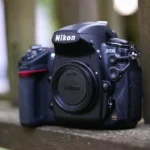
It is 2025. The world has largely moved on to mirrorless cameras with eye-detect autofocus that feels like cheating and video specs that rival cinema cameras. Yet, here I am, holding a tank of a DSLR from 2012: the Nikon D800.
For a long time, the D800 was the “dream camera.” When it launched, 36 megapixels wasn’t just high; it was unheard of in the 35mm format. It broke the internet before breaking the internet was a daily occurrence. But how does this 13-year-old behemoth handle the standards of 2025? Is it a hidden gem for budget photographers, or is it a frustration trap waiting to happen?
I recently picked one up for a steal of a price to find out. I paired it with some vintage “screw-drive” AF-D glass—the kind of lenses many budget shooters would likely use—and took it to the streets, parking garages, and forests to see if the legend holds up.
Let’s address the elephant in the room first: 36 Megapixels.
Even in 2025, 36MP is a lot. The standard for most entry-to-mid-level mirrorless cameras hovers around 24-26MP. When you load up a raw file from the D800, you are struck by the sheer amount of data. The cropping potential is immense. For landscape photographers or studio shooters on a budget, this sensor is still valid. It renders colors with that classic, deep Nikon aesthetic that many of us still prefer over the clinical look of modern sensors.
The D800 is a hefty beast, especially when paired with vintage glass like the 80-200mm f/2.8 D.
However, high resolution comes with a hidden cost, one that I learned the hard way during my testing.
The “Glass Ceiling”
The D800 is a glass snob. There is no polite way to say it. When Nikon released this camera, they effectively outpaced their own lens lineup.
I tested the camera primarily with older Nikon glass:
1. Nikkor 80-200mm f/2.8 AF-D (The legendary “two-touch” zoom from the 90s).
2. Nikkor 20mm f/2.8 AF (A compact wide prime).
3. Tokina 12-24mm f/4 DX (Used in crop mode/vignetted full frame).
Here is the harsh truth: Vintage glass struggles on this sensor.
The 80-200mm held up the best. It’s not perfect, but it produced usable, sharp images when stopped down slightly. However, the wide-angle lenses were a different story. The 20mm f/2.8, which I loved on my lower-resolution film bodies and the D700, looked soft and uneven on the D800. The sensor resolves so much detail that it exposes every single flaw, aberration, and softness in older optical designs.
If you are buying a D800 in 2025 to save money, be warned: you cannot cheap out on lenses. To get the most out of this camera, you really need the newer Nano-Crystal Coat (G-series) or Sigma Art lenses, which might cost more than the camera body itself.
Ergonomics: Muscle Memory Confusion
If you are coming from a D700 (the predecessor legend), the D800 might drive you slightly crazy.
Nikon, in their infinite wisdom, reshuffled the top deck buttons. The ISO button is not where you think it is; it swapped places with the Mode button compared to previous generations. It sounds like a minor nitpick, but when you are shooting in the field and relying on muscle memory, it’s infuriating. I found myself constantly hitting the wrong button to change exposure settings.
The button layout shift between the D700 (right) and D800 (left) is a nightmare for muscle memory.
Aside from that, the build quality is undeniable. This is a pro-grade body. It feels like you could hammer nails with it. The grip is substantial—perhaps a bit too chunky for small hands—but it balances heavy telephoto lenses perfectly. It’s heavy, yes, especially compared to a Nikon Z6 or Z7, but that weight provides stability.
The “Shutter Shock” and Technique
One of the biggest lessons I relearned shooting with the D800 is that you need to treat it like a medium format camera.
There is an old rule of thumb in photography for shutter speed: 1 / focal length. If you are shooting at 200mm, you need a shutter speed of 1/200s to avoid shake.
That rule is dead on the D800.
Because the pixel density is so high, even the tiniest micro-jitters from your hands or the mirror slapping up and down become visible. If you pixel peep at 100%, you will see motion blur where you didn’t expect it. I found myself needing to double my shutter speed (1/400s or faster for a 200mm lens) just to guarantee tack-sharp results. This camera demands discipline. It is not a “spray and pray” machine.
Field Test: The Urban Jungle
I took the camera to a multi-story parking garage known for its colorful vertical slats—a perfect test for moiré, contrast, and color rendition.
Despite the overcast, flat lighting, the D800 managed to pull out decent contrast. The dynamic range is still very workable in 2025. You can pull shadows significantly before the file falls apart, though obviously not as far as a modern backside-illuminated (BSI) sensor.
The D800 captures incredible detail in architecture, but requires precise technique to avoid micro-blur.
Telephoto compression with the 80-200mm looked great. Shooting from the garage roof towards the highway and train tracks, the isolation was pleasing. But again, I had to keep my shutter speeds high.
The Wide Angle Disappointment
Later, I went to a tunnel and a forest to test the wide angles. This is where the D800 broke my heart a little. Using the older 20mm AF-D, I just couldn’t get the crispness I wanted.
Old wide-angle lenses like the 20mm AF-D often look soft and muddy on the demanding 36MP sensor.
The corners were mushy, and even the center lacked that “pop.” It confirmed my suspicion: the D800 out-resolves the film-era wide-angle designs. If you are a landscape photographer, budget for a modern 14-24mm or 16-35mm. Do not expect your 30-year-old primes to perform miracles here.
Low Light Performance: The ISO Test
DSLRs from this era are often remembered fondly, but how noisy are they really?
I took the D800 into a dimly lit pedestrian subway tunnel. I pushed the ISO to 1600 and 3200.
In 2025 terms? It’s… usable.
At ISO 1600, there is visible grain, but it’s monochromatic and film-like. It cleans up well with modern AI noise reduction software (like Lightroom’s Denoise or Topaz). At ISO 3200, colors start to shift slightly, and the dynamic range drops off.
Low light performance is acceptable for 2012 standards, but don’t expect the night-vision capabilities of modern mirrorless cameras.
Compared to a modern Z8 or Sony A7IV, the D800 is archaic in low light. But if you expose to the right and don’t try to lift exposure by 5 stops in post, it is perfectly fine for professional work. Just don’t expect to shoot handheld in the dark without consequences.
A Note on Video
Don’t.
Just don’t.
Okay, technically the D800 shoots Full HD video. It was actually used on the set of Dexter and some other shows back in the day. But the autofocus in video mode is non-existent (contrast detect hunting), there is no peaking, no ibis, and the moiré is terrible. In 2025, your smartphone probably shoots better video. Buy this camera for photos, period.
The Verdict: Who is this for in 2025?
After spending time with the Nikon D800, I have a love-hate relationship with it.
You should buy a D800 in 2025 if:
* You are a landscape or studio photographer on a budget: You typically shoot at ISO 100 on a tripod. In this scenario, the D800 basically matches cameras that cost $3,000 today.
* You need high resolution: 36MP is still the sweet spot for large prints.
* You want to learn discipline: This camera forces you to learn proper hand-holding technique and exposure.
* You love the DSLR OVF: There is still nothing quite like looking through a real glass prism.
You should skip the D800 if:
* You rely on vintage/cheap glass: You will be disappointed by the softness.
* You need speed: The 4fps burst rate is sluggish.
* You shoot video: Look elsewhere.
* You hate weight: This is a heavy commitment to carry around.
The Nikon D800 remains a legendary camera, but it is a demanding mistress. It requires good glass and good technique. If you can provide those, it will reward you with images that still look world-class today. Just make sure you delete the muscle memory from your D700 first.