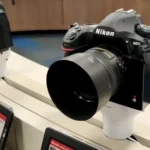
In the fast-paced world of 2025, where mirrorless cameras are pushing 60 megapixels and AI autofocus can track a bird’s eye through a dense forest, there is a quiet rebellion brewing. It’s a movement back to basics, back to tactile controls, and back to a specific “soul” in image making.
I’ve been revisiting a lot of legacy gear lately, but few cameras command respect quite like the Nikon D200. Originally released in late 2005, we are looking at a body that is now two decades old. Yet, despite its age, it remains one of my absolute favorite DSLRs to pick up and shoot.
If you are a student, a hobbyist on a shoestring budget, or a seasoned pro looking to break free from the clinical perfection of modern sensors, here is why the Nikon D200 is still a powerhouse choice in 2025.
The first thing that strikes you when you pick up a D200 today is the density. Modern cameras, even high-end ones, often incorporate high-grade composites and plastics to save weight. The D200 comes from an era where “professional” meant “metal.”
The magnesium alloy body and top-deck LCD offer a tactile experience that modern entry-level cameras simply cannot match.
The design philosophy here mirrors the legendary D2 series. It features a magnesium alloy chassis that feels like it could knock a nail into a wall. It is weather-sealed, rugged, and features a grip that actually fits a human hand comfortably.
In 2025, ergonomically, this camera still beats out many tiny mirrorless bodies that require pinky-extensions to hold properly. You have dedicated buttons for ISO, White Balance, and Quality. You aren’t menu-diving; you are driving the camera. For a learner, this muscle memory is invaluable.
The Magic of the CCD Sensor
This is the main event. Why are photographers in 2025 buying 20-year-old cameras? It’s the sensor technology. The D200 utilizes a 10.2-megapixel CCD (Charge-Coupled Device) sensor manufactured by Sony.
For those uninitiated, modern cameras use CMOS sensors. CMOS is efficient, great in low light, and fast. However, many enthusiasts argue that CMOS renders images in a somewhat “clinical” way. The older CCD sensors, like the one in the D200, are famous for their color science. They tend to render reds and greens with a richness and depth that feels more organic, almost akin to slide film.
The 10.2 megapixel CCD sensor might sound small by 2025 standards, but the pixel quality and color rendition are legendary.
Is 10 Megapixels Enough?
In an era of 8K video and 45MP sensors, 10 megapixels sounds laughable. But let’s be practical. If you are sharing photos on Instagram, X (Twitter), or even printing up to A4 size, 10 megapixels is plenty. The lower resolution actually works in your favor:
1. Storage: RAW files are small and manageable.
2. Computing: You don’t need a $3,000 MacBook Pro to edit the files; any old laptop can handle them.
3. Forgiveness: It’s less punishing on older lenses than a 45MP sensor would be.
The F-Mount Advantage
One of the strongest arguments for picking up a Nikon DSLR in 2025 is the lens ecosystem. The D200 utilizes the Nikon F-mount. This mount has been around since the late 1950s.
Because the D200 has a built-in focus motor (the “screw drive”), it is compatible with a massive library of AF and AF-D lenses from the 90s and 2000s. These lenses are optically fantastic but have plummeted in price because they don’t autofocused on Nikon’s newer Z-series mirrorless cameras without expensive adapters.
You can build a “holy trinity” of professional f/2.8 zoom lenses for the D200 for the price of a single modern mid-range prime lens. That is an unbeatable value proposition.
Field Test: The Reality of Shooting in 2025
Specs are one thing, but how does it actually perform when you step out into nature? I took the D200 out for a landscape and nature walk to test its viability against modern standards.
The Viewfinder Experience
We have become spoiled by EVFs (Electronic Viewfinders) that show exposure in real-time. However, looking through the D200’s optical pentaprism is a joy. It is bright, clear, and connects you directly to the scene without lag or digital interpretation. It also contributes to the stellar battery life—since there’s no screen constantly draining power, you can shoot for days on a single battery.
Dynamic Range and Exposure
I took the camera out to capture some rural scenery—barns, fields, and dirt roads.
The CCD sensor shines in good light, rendering the greens of the grass and the red of the barn with a distinct, punchy aesthetic.
The images straight out of the camera (SOOC) have a distinct look. While some claim it looks exactly like film, I’d argue it looks like classic digital. It reminds me of the Canon 5D Classic or the Nikon D2X. It’s grounded and realistic.
However, you have to be careful with highlights. CCD sensors do not have the dynamic range of modern Sony or Canon sensors. If you blow out the sky, that data is gone. It teaches you to be a better photographer because you have to nail your exposure in-camera.
Autofocus and Wildlife
I spotted some horses in a field and decided to test the AF-C (Continuous Autofocus).
Using older AF lenses like the 70-210mm requires patience, but the results have a beautiful, nostalgic rendering.
The autofocus system is from 2005. It has 11 points. By 2025 standards, it is “primitive.” It hunts a little more in low light, and it doesn’t have “Animal Eye AF.” You have to focus and recompose or manually select your point. But it works. It forces you to slow down.
The major limitation I found—and this is the D200’s Achilles heel—is high ISO performance.
The ISO Limitation
Modern cameras can shoot at ISO 6400 or even 12,800 without breaking a sweat. The D200? Not so much.
Once the sun started to dip and I was shooting in the woods, I had to bump the ISO. The D200 is really a “Base ISO” camera. It loves ISO 100 or 200. Once you push past ISO 800, chroma noise (color splotches) and grain become very apparent.
Unlike the pleasant grain of the Nikon D700 or D3 (which came later), the D200’s noise can be a bit ugly if you aren’t careful. This is strictly a daylight or tripod camera. If you are a handheld night street photographer, this isn’t the tool for you.
In soft, evening light, the D200 captures a painterly atmosphere that many photographers spend hours trying to replicate with presets.
The “Film Look” Myth vs. Reality
There is a pervasive myth online that CCD sensors = Film.
Does the D200 look like a roll of Portra 400? No, not really. It looks like a digital camera. However, because the RAW files are so malleable and the color starting point is so different from modern CMOS sensors, it is easier to grade them to look like film.
The files have a “thick” feeling to them. The contrast curves straight out of the camera are usually punchier. It lacks that flat, grey, HDR look that modern phone cameras produce. In that sense, it shares a philosophy with film, if not the exact grain structure.
Verdict: Should You Buy One in 2025?
The Nikon D200 typically sells for between $60 and $120 on the used market in 2025. That is the price of a couple of SD cards.
You should buy the D200 if:
* You want to learn the fundamentals of exposure (ISO, Aperture, Shutter) on a body that won’t do the work for you.
* You love the “CCD Look” and shoot mostly in daylight.
* You want a cheap, rugged camera for hiking or travel that you won’t cry over if it gets dinged.
* You have a stash of old Nikon F-mount lenses.
You should skip the D200 if:
* You shoot sports or fast-moving wildlife (the buffer fills up fast).
* You shoot indoors or at night (ISO performance is poor).
* You need video capabilities (it doesn’t shoot video at all).
The Nikon D200 is a reminder that photography is about the process, not just the specs. Shooting with this camera in 2025 was a breath of fresh air. It slowed me down, made me appreciate the light, and delivered images that, despite the 10MP limit, have a timeless quality that 8K resolution simply cannot replicate.