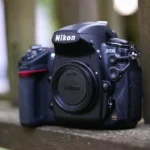
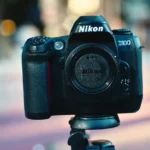
In a world obsessed with 50-megapixel monsters, 8K video, and autofocus systems that can track a bird’s eye through a hurricane, there is a quiet, growing rebellion. It’s a movement back to simplicity, back to “soul,” and strangely enough, back to 2005.
I recently found myself standing in a bomb shelter—not because of an apocalypse, but because the acoustics were good and the outside world had frozen over—holding a camera that cost me less than a sandwich and a coffee.
I’m talking about the Nikon D50.
I paid 15 Euros for this camera. Let that sink in for a moment. That is roughly the price of a single roll of Portra 400 film today. Yet, this 18-year-old plastic brick is arguably one of the most charming entry points into the “CCD Renaissance” that photographers are currently raving about. Is it perfect? Absolutely not. Is it worth your time? Let’s dive deep into why this ancient DSLR might just be the cure for your modern gear acquisition syndrome.
The CCD Sensor Cult: Why 6 Megapixels is Enough
If you look at the spec sheet of the Nikon D50 today, you might laugh.
* Sensor: 6.1 Megapixel CCD (DX format)
* ISO: 200 – 1600
* Screen: 2.0 inch LCD (barely usable by modern standards)
But numbers tell lies. The magic of the D50, and its big brother the D70, lies in that acronym: CCD (Charge-Coupled Device).
Before CMOS sensors took over the world with their clean, clinical high-ISO performance and video capabilities, CCD sensors ruled the earth. Photographers often describe CCD images as having a more “film-like” quality. The colors are punchier, the highlights roll off differently, and the noise—when it appears—feels more like organic grain than digital artifacting.

When you shoot with a D50, you aren’t cropping in 400%. You are composing carefully because you only have 6 megapixels to work with. But for Instagram, web viewing, and even prints up to 8×10, 6 megapixels is plenty. It forces you to be a photographer, not a pixel peeper.
Build and Handling: The “Baby D70”
The D50 was essentially released as a lighter, more consumer-friendly version of the legendary Nikon D70. In the hand, it feels surprisingly robust for a “plastic fantastic” camera. The grip is deep and comfortable, typical of Nikon’s ergonomic dominance during that era.
However, there are some quirks that you need to be aware of if you’re coming from modern cameras or even the D70:
1. The Missing Dial
The biggest omission on the D50 is the front command dial. On pro Nikon bodies, you have a rear wheel for shutter speed and a front wheel for aperture. On the D50, you only have the rear wheel.
To change the aperture in Manual mode, you have to hold down a button near the shutter release and spin the rear dial. It’s muscle memory you can learn, but it definitely slows you down compared to a dual-dial setup.
2. The SD Card Advantage
Here is where the D50 actually beats its professional older brothers from the same era. While the D70 and D200 used Compact Flash (CF) cards—which are now bulky, expensive, and require special readers—the D50 uses a standard SD Card.
Note: It usually only accepts standard SD cards (up to 2GB), not SDHC or SDXC, though some users report luck with non-SDHC 4GB cards. It’s strictly “old school.”
3. Simplified Controls
The top LCD is fantastic to have on a budget camera, giving you instant readout of your settings. However, Nikon removed the physical lock switch for the focus points on the back, and the buttons are slightly different from the pro layouts. It’s simplified, but not “dumbed down” to the point of frustration.

The Secret Weapon: The “Screwdriver” Motor
One of the absolute best features of the Nikon D50—and something Nikon sadly removed from their later entry-level cameras like the D3000/D5000 series—is the built-in focus motor.
If you look at the lens mount, you’ll see a little metal tab that looks like a flathead screwdriver tip. This means the D50 can autofocus with older Nikon AF-D lenses.

Why does this matter?
Because the vintage AF-D lenses are:
1. Cheap: You can get a 50mm f/1.8 D for next to nothing.
2. Optical Gems: They have a classic rendering that matches the CCD sensor perfectly.
3. Abundant: There are millions of them on the used market.
By pairing a $15 body with a $50 lens, you have a setup that produces images with more character than a $1000 smartphone.
Field Test: Battling the Elements
To truly test the mettle of this geriatric device, I took it out of the bomb shelter and into the Finnish winter. We are talking about conditions where the temperature dropped to -8°C (approx 17°F).
This is where the reality of using 18-year-old electronics hits you.
The Battery Struggle
Old batteries do not like the cold. Lithium-ion chemistry degrades over time, and when you combine a nearly two-decade-old battery with freezing temperatures, the voltage drops off a cliff. My session was cut short because the battery simply gave up.
* Pro Tip: If you buy a D50 today, buy a brand new third-party battery. Do not rely on the original grey Nikon battery that comes with it.
Mechanical Hiccups
In the extreme cold, lubricants inside cameras can thicken. I experienced a moment where the mirror seemed to stick, or the shutter lagged. It’s a mechanical device, after all. It’s not weatherproofed like a D200 or D3, so treat it with a bit of care in harsh environments.
The Metering quirk
Nikon’s Matrix Metering is generally famous for being reliable. However, on the D50, I noticed a tendency to prioritize the highlights in high-contrast scenes (like a dark barn against a bright snowy sky), leading to underexposed subjects. Or conversely, getting confused by the snow.
The LCD screen on the back is not reliable for judging exposure—it’s too low resolution and the brightness is deceptive. You must learn to read the histogram. The D50 allows you to view the histogram, and that is your source of truth.

Image Quality: The “Liminal” Aesthetic
So, how do the photos actually look?
If you are a pixel peeper who zooms in to see individual eyelashes, this camera is not for you. But if you look at the image as a whole, there is a distinct beauty to the output.
Colors
The Daylight White Balance on the D50 produces gorgeous, warm, natural tones. Greens look like vegetation, not neon radiation. Skin tones (though not tested in this landscape session) are legendary on these Nikon CCD bodies.
The Noise
Here is a controversial opinion: The digital noise on the Nikon D50 is beautiful.
At ISO 800 and 1600, the camera produces a lot of noise. But unlike the ugly color blotches of modern sensors, the D50’s noise looks monochromatic and gritty. It adds texture.
I found this camera perfect for shooting “Liminal Spaces”—those eerie, transitional locations like empty parking garages, snowy industrial yards, or abandoned buildings at dusk. The low dynamic range and the high noise floor contribute to an atmosphere of isolation and nostalgia that is very difficult to fake with filters.

Dynamic Range
Do not expect to pull 5 stops of shadow detail out of these RAW files. If you underexpose significantly, the shadows will be crushed and noisy. You have to shoot this camera like slide film: Nail your exposure in camera.
The Verdict: Who is this for?
The Nikon D50 sits in a weird spot. It is cheaper than the D70, D80, or D200, but it is also more limited.
You should buy a Nikon D50 if:
* You want to experience the “CCD Look” for the absolute lowest price possible.
* You have a stash of old Nikon AF-D lenses.
* You want a camera that feels disposable enough to take into risky situations (skateboarding, parties, harsh weather) where you wouldn’t risk your Sony A7IV.
* You are tired of the clinical perfection of modern cameras and want a challenge.
You should look elsewhere if:
* You need high-resolution prints.
* You need video (it doesn’t shoot video).
* You shoot fast-moving sports (the buffer and AF are okay, but not great).
* You hate menu diving (though the D50 is relatively simple).
Alternatives in the Vintage Market
- Nikon D70/D70s: Almost the same image quality, but with two command dials (better ergonomics) and CF cards.
- Nikon D200: The King of CCDs. Better build, weather sealing, much faster, but heavier and more expensive.
- Canon 10D/20D: The Canon equivalents. They use CMOS sensors (mostly), which have a different look—smoother, softer, but perhaps less “character” than the Nikon CCDs.
Final Thoughts
We are living in an era where film photography has become prohibitively expensive for many. A roll of film plus development and scanning can run you $25-$30. The Nikon D50 body costs $15-$20.
It provides a similar constraint-based shooting experience. You have limited ISO, limited resolution, and a limited buffer. These limitations force you to slow down, think about your light, and compose with intent. And when you get it right, the image has a soul that rivals celluloid.
It might be a relic from 2005, kept alive in a bomb shelter, but the Nikon D50 is a reminder that you don’t need the latest gear to create art. You just need a box that captures light, and a willingness to brave the cold.