If you go down to the woods today, you might find something strange. Not a bear, but a relic from the dawn of the digital SLR revolution. I’m talking about the year 2002, a time when the rules of digital photography were still being written, and manufacturers were willing to take bizarre, wonderful risks.
Today, I want to take you on a journey back to that era with one of my absolute favorites: the Fujifilm FinePix S2 Pro.
To the untrained eye, it looks like a chunky Nikon. To the connoisseur, it is a “Frankenstein” masterpiece—a camera that combines the mechanical reliability of a Nikon film body with the unique, color-science wizardry of a Fujifilm digital back. It is weird, it is charming, and nearly two decades later, it produces images that possess a soul many modern cameras lack.
Let’s dive deep into this ancient DSLR and see why the S2 Pro still deserves a spot in your camera bag.
The first thing you notice when holding the S2 Pro is a sense of déjà vu. If you have ever shot with a Nikon F80 (or N80 in the US) film camera, you already know how this camera feels. That’s because, quite literally, the front half of this camera is a Nikon F80.
In the early 2000s, electronics companies like Fujifilm didn’t have the tooling to build high-precision shutters and mirror boxes. So, they improvised. They bought bodies from Nikon and grafted their own digital technology onto the back.
Because it is built on the F80 chassis, the S2 Pro uses the legendary Nikon F-mount. This is a massive advantage. You have access to decades of Nikkor glass, from vintage manual focus AI-S lenses (though metering is limited) to the modern AF-D autofocus lenses that scream 90s nostalgia. It uses Nikon Speedlights and Nikon remote releases. For a Nikon shooter, picking this up feels like coming home, just a slightly heavier home.
The “Frankenstein” Design
The integration is where things get interesting. The camera is tall—much taller than a standard F80—because the bottom section houses the digital processing unit and batteries. It feels substantial in the hand. The grip is deep and generous; my fingers wrap around it with room to spare, making it comfortable for long walks in the forest.
However, because the chassis was originally designed for 35mm film, the mirror inside is full-frame sized. Yet, the sensor behind it is APS-C (cropped). When you look through the viewfinder, you are looking through a tunnel designed for a larger format, masked off for the smaller digital sensor. It’s a quirk of history that we don’t see anymore.
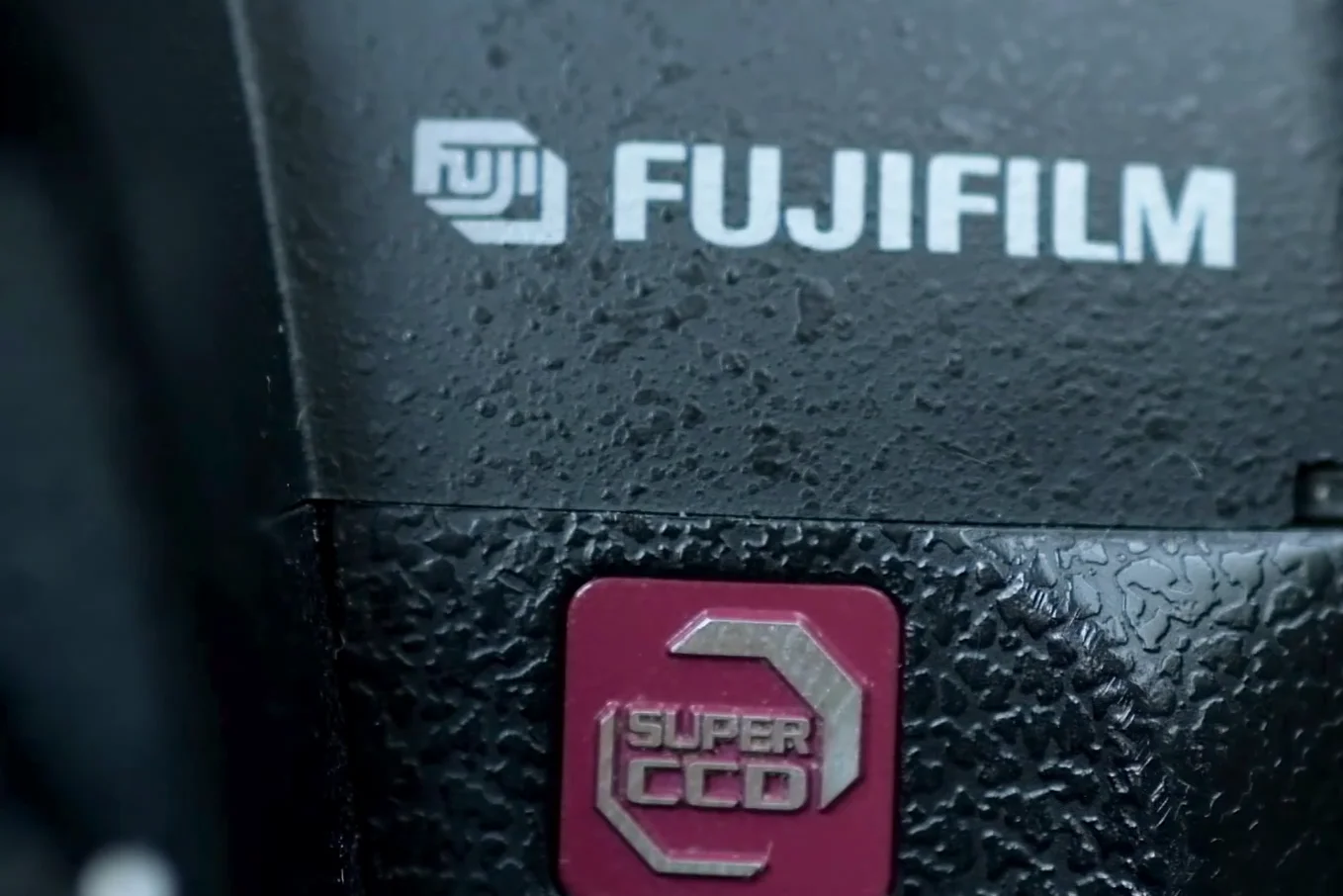
The legendary Super CCD badge, signifying a unique sensor architecture.
The real reason anyone still talks about the S2 Pro today isn’t the Nikon body; it’s the Fujifilm sensor. This camera sports a 6-megapixel Super CCD sensor.
Now, you might be thinking, “Six megapixels? My doorbell has more than that.” But numbers don’t tell the whole story, especially when it comes to Fujifilm.
The Honeycomb Revolution
Standard sensors use a square grid of pixels. Fujifilm, leaning on their expertise in film grain structure, decided to do something different. They rotated the pixels 45 degrees, creating an octagonal “honeycomb” layout.
Why? The theory was that because human vision and most patterns in nature (and architecture) rely heavily on horizontal and vertical lines, a diagonal pixel structure could resolve detail more efficiently.
This unique layout allowed the S2 Pro to do something controversial: Interpolation.
The camera takes its 6 million physical pixels and, using complex algorithms derived from that honeycomb layout, outputs a 12-megapixel file.
Is it “Real” Resolution?
Technically, no. It is a 6MP sensor. But practically? It’s complicated. At the time, the S2 Pro punched well above its weight class. However, looking at the 12MP files today, especially when zooming in to 100%, you can see the cracks in the illusion. The pixel detail isn’t razor-sharp like a modern sensor. You might see jagged edges on diagonal lines or strange digital artifacts that look like glitches in the matrix.
For my money, treating this as a high-quality 6MP camera is the sweet spot. The images are cleaner, and you avoid the interpolation artifacts. But even with the glitches, there is a texture to the images that feels less “digital” and more organic.
If you think modern menu systems are complicated, the S2 Pro will leave you bewildered—and then charmed. Because the camera is effectively two devices glued together, the interface reflects that split personality.
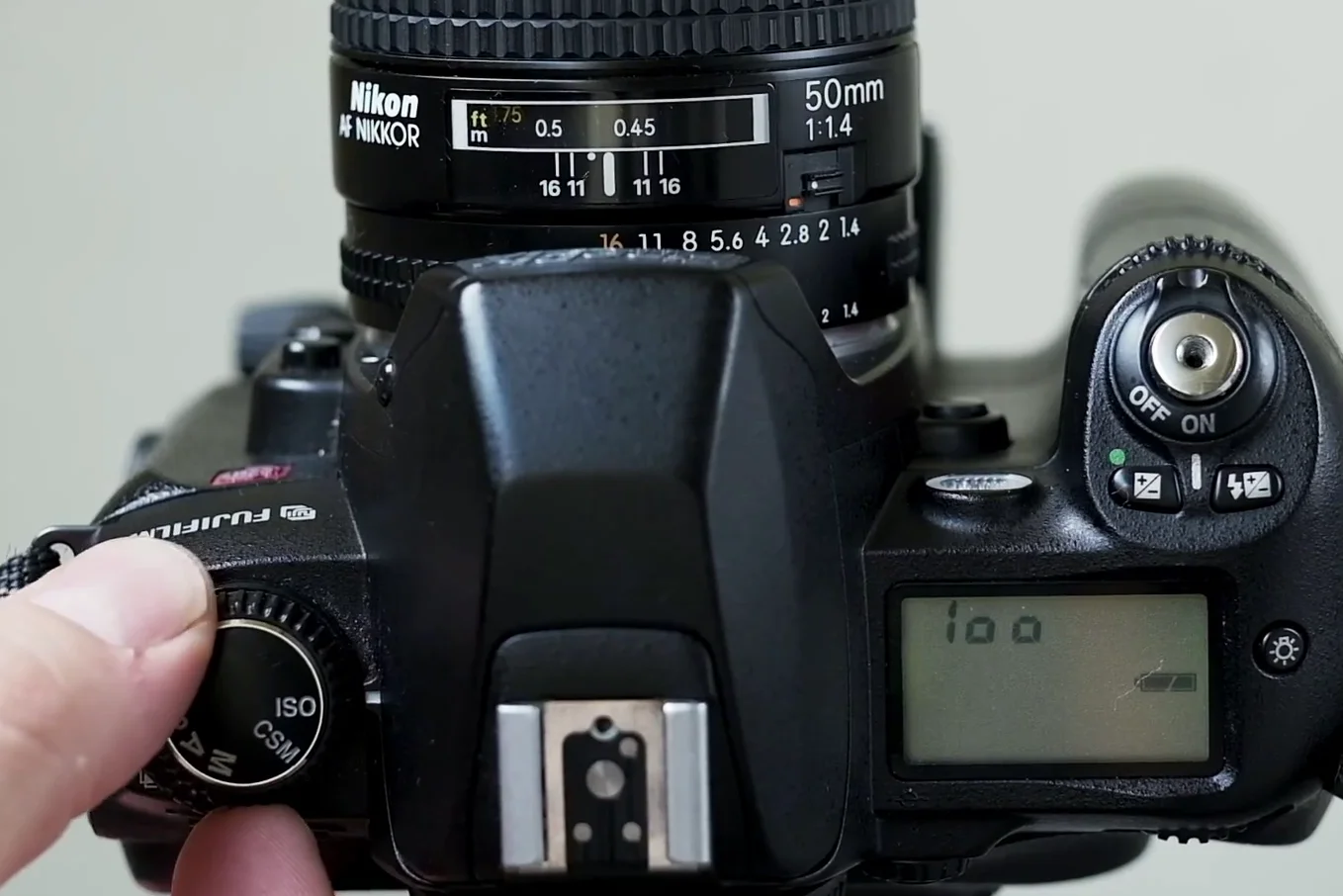
Three screens, one camera. The complex control center of the S2 Pro.
The Three-Screen Setup
Yes, this camera has three separate LCD screens.
1. Top Deck LCD: This is pure Nikon F80. It shows your shutter speed, aperture, and battery life for the mechanical parts.
2. Rear “Function” LCD: Located just below the viewfinder, this small strip handles the digital settings—ISO, white balance, and resolution.
3. Main Rear LCD: Used for reviewing images and deep menu dives.
It sounds chaotic, having to look in three different places to change settings. The ISO isn’t changed via a button and a dial like on a Nikon D100; you have to navigate the Fuji interface on the back. It forces you to slow down. You have to be deliberate. In a world of touchscreens and instant feedback, this mechanical, segmented workflow feels almost therapeutic, like operating a cockpit.
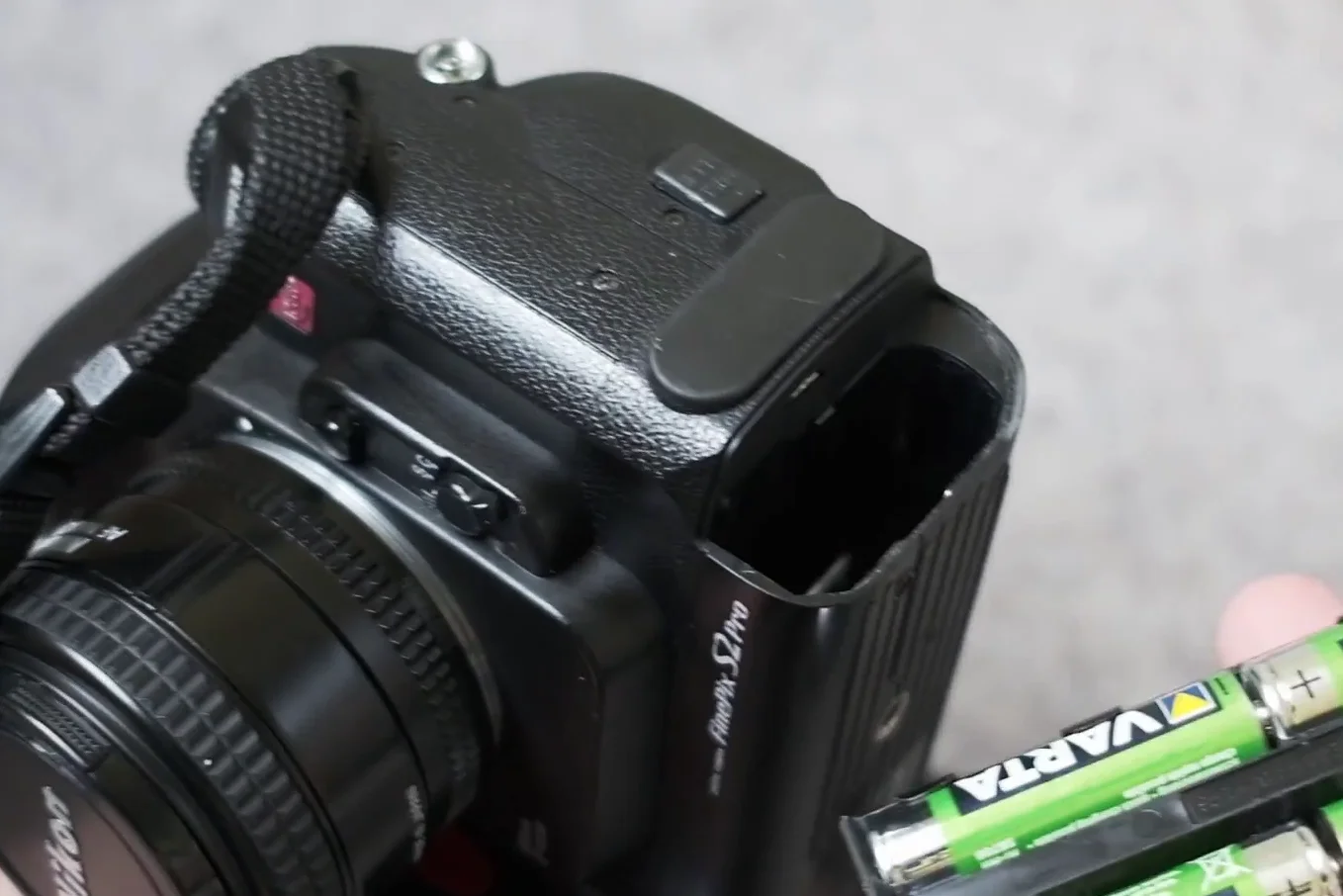
The dual battery system requires a mix of AA and CR123 cells to power different parts of the camera.
The Battery Madness
The most “Frankenstein” aspect of all is the power source. The S2 Pro originally demanded:
* 4x AA batteries in the tray for the digital brain.
* 2x CR123 lithium batteries in the grip to power the autofocus motor and flash.
* 1x Coin cell battery just to keep the date and time.
That is three different types of batteries to run one camera. Fortunately, there is a workaround. You can actually run the camera entirely on the 4 AA batteries. You lose the built-in pop-up flash (which draws from the CR123s), and the autofocus might feel a tad slower, but it works perfectly fine. Given that built-in flashes are rarely flattering anyway, sticking to rechargeable AAs is the way to go.
We don’t use 20-year-old cameras for their dynamic range or their burst speed (which is sluggish on the S2 Pro). We use them for Color.
Fujifilm has always been a film company first and a tech company second. While Canon and Nikon were chasing resolution and noise performance, Fujifilm seemed obsessed with how the camera rendered red, greens, and skin tones.
The S2 Pro renders colors with a distinct, nostalgic warmth that mimics classic film stocks.
Colors Straight Out of Camera
The JPEG files from the S2 Pro are stunning. There is a richness to the reds and a density to the greens that mimics slide film like Velvia or Provia. The auto white balance can be a bit erratic—especially in snowy, winter conditions where it struggles to find neutral gray—but when it hits, it hits hard.
Skin tones, a hallmark of the later S3 and S5 Pro, are already excellent here. There is a reason wedding photographers clung to these cameras long after they were obsolete; they made people look healthy and vibrant without hours of Photoshop work.
The Texture of Noise
When you push the ISO up, or when you shoot long exposures at night, the camera introduces noise. But unlike the ugly, color-blotchy noise of modern CMOS sensors, the CCD noise on the S2 Pro is monochromatic and tight. It looks surprisingly like film grain.
I found myself enjoying night photography with this camera immensely. It renders artificial streetlights with a pleasing glow, and the “imperfections” in the file structure add to the atmosphere rather than detracting from it. It’s moody. It creates images that feel like memories rather than clinical records of reality.
Is it perfect? Absolutely not.
* Dynamic Range: By modern standards, the highlights clip easily. If you overexpose the sky, it’s gone. The later S3 and S5 Pro introduced dual-pixel technology to fix this, but the S2 Pro is strictly “expose for the highlights” territory.
* Speed: Writing a RAW file to the Compact Flash card takes time. You take a shot, and you wait. You are not shooting sports with this camera.
* The Glitch: Occasionally, you will see strange artifacts. In one of my test shots of a greenhouse, the intense highlights caused a weird diagonal banding pattern—a direct result of that honeycomb sensor layout freaking out.
But these aren’t dealbreakers; they are character traits.
Even with 6 megapixels, the texture and detail are sufficient for compelling, atmospheric photography.
The Fujifilm FinePix S2 Pro is a time capsule. It represents a specific moment in history where mechanical engineering collided with digital innovation in a messy, beautiful way.
If you are looking for a camera to do professional work today, look for a Nikon D850 or a Fuji X-T5. But if you are looking for a creative tool—something to spark joy, to slow you down, and to give you colors that require zero editing—the S2 Pro is a gem.
It is distinct from its contemporaries. The Canon 10D and Nikon D100 from the same era produced lovely images, but they feel more like early versions of today’s cameras. The S2 Pro feels like a different species entirely.
The prices for these units are creeping up as more photographers rediscover the magic of CCD sensors. Finding one in good working order, with clean battery contacts and a working sensor, is getting harder. But if you do find one, grab it. Put some fresh AA batteries in it, attach a cheap 50mm Nikon lens, and head into the forest. You might just fall in love with photography all over again.