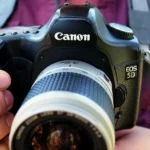
There is a pervasive myth in modern photography that better gear equals better photos. We are constantly bombarded with marketing for 50-megapixel sensors, 8K video capabilities, and autofocus systems that use AI to track a bird’s eye through a hurricane. But what happens when you strip all of that away? What happens when you step back nearly two decades to a time when “Digital Rebel” was a revolutionary concept?
Recently, I decided to leave my modern mirrorless kit at home and head into the forest with a relic from 2005: the Canon EOS 350D, known in North America as the Rebel XT and in Japan as the Kiss Digital N.
This isn’t just a review of old specs; it’s an exploration of whether an entry-level DSLR that costs less than a fancy dinner can still capture the soul of a landscape. Spoiler alert: It absolutely can, but you have to work for it.
The Time Machine: First Impressions of 2005
Holding the 350D in your hand today is a tactile history lesson. Released in the spring of 2005, this camera was the successor to the groundbreaking 300D. At the time, it was a marvel of miniaturization. Today, it feels incredibly compact, almost toy-like compared to the chunky pro bodies of its era.

The first thing that strikes you is the plastic construction. It doesn’t have the cold, magnesium-alloy confidence of a 5D, but it’s lightweight. This makes it surprisingly perfect for hiking. You can throw this in a backpack and barely feel it.
However, the “retro” charm comes with what we might now consider quirks. The screen situation is… interesting. Unlike modern cameras where everything happens on one big rear LCD, the 350D splits its personality. You have a monochrome status LCD above the main screen (a feature usually reserved for pro cameras on the top plate) displaying your shutter speed, aperture, and shots remaining. Below that is a microscopic 1.8-inch color LCD.
Reviewing photos on this screen is a lesson in faith. It’s small, dim by modern standards, and really only good for checking the histogram or composition. You won’t be checking critical focus here; you have to trust your skills and the autofocus system.
The Specs: Why 8 Megapixels is Enough
Let’s address the elephant in the room: 8 Megapixels.
In an age where our phones shoot 48MP, 8 sounds laughable. But here is the secret that camera manufacturers don’t want to shout about: 8 megapixels is plenty for 90% of use cases. That gives you a resolution of roughly 3456 x 2304.
* Is it enough for Instagram? Yes (overkill, actually).
* Is it enough for a 4K monitor? Yes (4K is roughly 8MP).
* Is it enough for an A4 print? Absolutely.
The sensor is an APS-C CMOS, a technology Canon was pioneering while others were still stuck on CCD. The result is an image that, even by today’s standards, has a pleasing, organic quality. It lacks the clinical over-sharpening of modern sensors.
Limitations as Creative Constraints
The camera does have hard limits. The ISO range tops out at 1600, and quite frankly, you want to stay at 400 or below if you want clean images. There is no video mode. None. This is a stills-only machine, which I found incredibly liberating. When you can’t shoot video, you stop thinking about motion and start focusing entirely on the frozen moment.
Ergonomics and Field Usability
Taking this camera out to the rocky coastlines and pine forests revealed its true character. The grip is notoriously small. If you have large hands, your pinky finger will be dangling in the void. However, Canon did release a battery grip (BG-E3) for this model, which I highly recommend if you want stability.

The control layout is a mix of genius and frustration.
* The Good: There are dedicated buttons for ISO, AF mode, and White Balance on the back (the arrow keys).
* The Bad: To change settings like aperture in Manual mode, you have to hold down a button and scroll the single wheel near the shutter. It requires some finger gymnastics that take getting used to.
One specific quirk of this era is the menu system. To change White Balance, you can use the shortcut, but diving into the menus feels like navigating an old Nokia phone. Yet, once you set it up to shoot RAW, you rarely need to touch the menus again.
The Battery Situation
A practical tip for anyone buying one of these used: The 350D uses the NB-2LH battery, which is smaller than the BP-511 used in the bigger Canons of that time. They are cheap and easy to find. However, if your camera refuses to turn on, check the clock battery. There is a tiny drawer in the battery compartment for a CR2016 cell. If this dies, the camera can sometimes act bricked or forget its settings constantly.
The Secret Sauce: Glass Selection
A camera body is just a light-tight box; the lens provides the magic. For this field test, I paired the 350D with the Canon EF-S 10-22mm f/3.5-4.5 USM.

This is a crucial point. If you put the cheap 18-55mm “kit lens” from 2005 on this camera, you will get 2005-looking snapshots. But if you mount quality glass, the 350D sings. The 10-22mm is a fantastic ultra-wide lens. It allows for dramatic perspectives, elongating the trees and emphasizing the foreground rocks.
This combination—a cheap body ($30-$50) and a decent lens ($150-$200)—is the smartest way to build a budget landscape kit. The money creates better results in the glass than it does in the body.
Performance in the Wild
Walking through the forest, the speed of the camera surprised me. We tend to think of old tech as sluggish, but the 350D boots up almost instantly. The shutter lag is minimal. It can shoot 3 frames per second, which is sluggish for sports but perfectly adequate for landscapes and portraits.
The autofocus uses a 7-point system. It’s primitive compared to modern Dual Pixel AF, but for static subjects like trees and rocks, it locks on with a reassuring beep.
The most nostalgic part? The sound. The shutter mechanism on the 350D has a distinct, high-pitched clack-whir sound. It’s not the damp, polite whisper of a mirrorless shutter. It’s mechanical. It lets you know you’ve taken a photo.
Image Quality: The “Canon Colors”
So, how do the photos actually look?
I waited for the golden hour, setting up shots of lonely pine trees against the shimmering sea. This is where the 350D shines. The “Canon Color Science” that people rave about is present here in its rawest form. Skin tones (not tested here, but generally known) are excellent, but the way it renders greens and blues in nature is lovely.

The dynamic range is the biggest hurdle. Modern sensors let you pull details out of deep shadows effortlessly. The 350D is less forgiving. If you underexpose too much, the shadows get noisy and muddy. If you overexpose, the highlights clip to pure white quickly.
This forces you to be a better photographer. You have to learn to “expose to the right” (ETTR) using the histogram. You have to use graduated filters or bracket your shots. The camera doesn’t save you; you have to save the image.
However, shooting in RAW gives you enough latitude to create stunning images. The 10-22mm lens provided sharp details across the frame, and the 8MP sensor resolved enough texture in the moss and bark to make the images feel professional.
Post-Processing Files from 2005
Importing the .CR2 files into Lightroom is a breeze. Because the files are small (around 8-10MB), they load instantly. You don’t need a supercomputer to edit them.
I found that the files respond well to contrast and saturation adjustments. While you can’t push them as hard as a Sony A7 file, the grain structure at ISO 100 and 200 is very film-like. It’s not the ugly color noise you get from smartphones; it’s a luminance grain that adds texture.
Verdict: Should You Buy One?
The Canon EOS 350D sits in a unique spot in the used market. It is often cheaper than a memory card.
You should buy this camera if:
1. You are a beginner on a tight budget: You can learn the exposure triangle (Aperture, Shutter, ISO) just as well on this as on a $2000 camera.
2. You want a “beater” camera: Something you can take camping, climbing, or to the beach without worrying about damaging expensive gear.
3. You want a distinct look: The CCD/early CMOS sensors have a vibe that is distinct from the hyper-clean modern look.
4. You want to disconnect: No video, no wifi, no touch screen. Just photography.
Skip it if:
1. You shoot sports or fast action (autofocus will struggle).
2. You need high ISO performance for night shooting.
3. You rely heavily on cropping (8MP doesn’t allow much cropping).
Conclusion
Standing on a granite cliff overlooking the archipelago, watching the sun dip below the horizon, I didn’t miss my modern camera. The 350D captured the scene beautifully.

There is a profound satisfaction in squeezing performance out of limited tools. It reminds you that photography is about your eye, your composition, and your understanding of light. The Canon EOS 350D is nearly 20 years old, but the light it captures is timeless. If you have $30 and an itch to explore, pick one up. You might just find that going back in time helps you move forward as a photographer.