In the fast-paced world of photography, where manufacturers are in a constant arms race for higher megapixels, faster autofocus, and 8K video capabilities, there is a quiet rebellion brewing. It’s a movement back to basics, back to “soul,” and often, back to older technology.
Today, I’m taking a step back to 2006. The air is crisp, the ground is a mix of thawing mud and stubborn ice, and in my hands rests a camera that many have forgotten: the Nikon D80.
As I walked through the stark, late-winter landscape, I wanted to answer a burning question: Can a DSLR nearly two decades old still hold its own in 2024? And more importantly, is the legendary “CCD sensor magic” actually real, or just nostalgic hype?
Let’s address the elephant in the room immediately. If you are looking for a hybrid camera to shoot cinematic vlogs or rapid-fire sports, the Nikon D80 is not for you. It doesn’t shoot video. At all. And honestly? That is its greatest strength.
Using the D80 forces a shift in mindset. It strips away the distractions. When you pick up this body, you are there to take photographs, nothing else. There is a purity to that purpose that modern mirrorless cameras, with their endless menus and video codecs, sometimes lack.
Ergonomics: The Goldilocks Zone
Holding the D80 instantly reminds you why Nikon dominated the DSLR era. It sits in a perfect middle ground—the “Goldilocks” zone of camera bodies.
The Nikon D80 (right) refined the design of its predecessor, the D70, offering a slightly more compact yet robust build.
Compared to its predecessor, the D70, the D80 feels slightly more refined and compact. However, it retains enough bulk to balance well with heavier glass, something tiny mirrorless bodies struggle with today. It is significantly lighter than its big brother, the semi-professional D200. While the D200 is built like a tank with full weather sealing, it can be a burden on long hikes. The D80 offers a substantial grip and solid build quality without weighing you down, making it a surprisingly excellent option for travel photography even today.
Controls and Usability: A Mixed Bag
Nikon’s design philosophy has always been about putting control at your fingertips, and the D80 largely succeeds here. You get the dual command dials—front and back—which are essential for shooting in Manual or Aperture Priority modes comfortably. The tactile feedback of the shutter and the buttons doesn’t feel “cheap,” despite the camera’s age.
However, it’s not without its quirks.
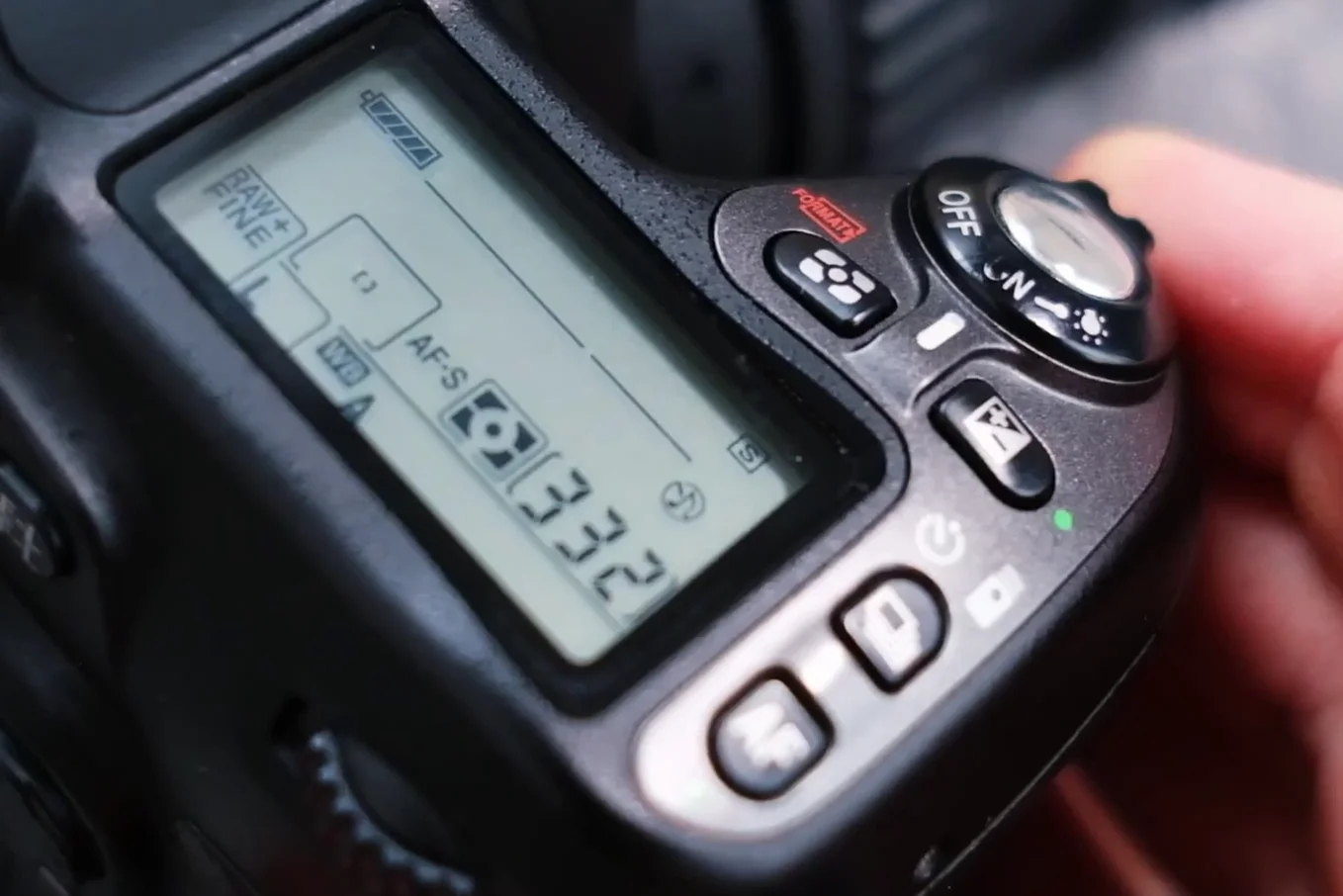
The top LCD is handy, but the placement of the ISO and White Balance buttons requires some finger gymnastics.
If you are coming from modern cameras, or even the pro-level D200, the button placement for ISO and White Balance might frustrate you. They are located on the left shoulder, requiring you to hold a button and scroll a dial. It’s not as intuitive as the dedicated ISO buttons near the shutter release found on later models. It’s a small grievance, but one that reminds you of the ergonomic experiments of the mid-2000s.
On the positive side, the D80 is a reliable workhorse. Unlike the D70, which was notorious for “Memory Card Error” glitches and occasional underexposure issues (the “BGLOD” or Blinking Green Light of Death), the D80 is much more stable. It’s a camera that just works when you turn it on.
The Heart of the Matter: The 10MP CCD Sensor
Why are photographers buying these old cameras? It’s rarely for the resolution—though 10.2 megapixels is still perfectly adequate for Instagram, web use, and even prints up to A4 size. The real draw is the CCD sensor.
Modern cameras use CMOS sensors, which are fantastic at high ISOs and have great dynamic range, but some argue they produce “clinical” or flat images. The D80 uses a CCD (Charge-Coupled Device) sensor, the same technology found in the acclaimed D200.
The “Film-Like” Quality
There is a distinct color science to these older sensors. In good light, the colors render with a density and richness that mimics slide film. The reds are punchy, the greens are deep, and the skin tones have a natural warmth.
Walking along the frozen lake, photographing the textures of the reeds and the peeling paint of the boats, the D80 captured the scene with a gritty reality. The images have grain—especially as you push the ISO past 400—but it looks more like organic film grain than digital noise.
The D80 shares the same 10MP CCD sensor as the pro-grade D200, delivering identical image quality in a lighter package.
While the D200 reads data from the sensor faster (allowing for higher frames per second), the actual raw data—the image quality—is identical between the two. If you want that specific CCD look but don’t want to carry the weight of a D200, the D80 is the secret weapon.
Lens Compatibility: What You Need to Know
One of the major advantages of the Nikon F-mount ecosystem is the legacy glass. The D80 features an internal focus motor (the “screw drive”), which means it can autofocus with older AF and AF-D lenses. This opens up a world of incredibly sharp, cheap, and character-rich vintage lenses.
For this walk, I used a Tokina 12-24mm f/4 and a Sigma 17-50mm. The wide-angle perspective highlighted the vastness of the frozen landscape.
A Note on Manual Lenses:
It’s important to note a limitation. Unlike the D200 and upwards, the D80 lacks the “aperture indexing tab” (Ai tab). This means if you mount fully manual vintage Nikon lenses (Ai or Ai-S), the camera’s light meter will not work. You have to shoot completely manually—guessing your exposure and checking the histogram (the “chimping” method). It’s doable, but it slows you down significantly. If you own a lot of manual glass, the D200 is the better choice.
The Field Test: Winter’s End
Taking photos with the D80 is a rhythmic experience. Compose, check settings, clack. The shutter sound is distinct—softer than the machine-gun fire of a pro body, but decisive.
Even in harsh, high-contrast winter light, the D80 manages to balance highlights and shadows with a pleasing roll-off.
I focused my lens on the boats resting on the hard ground—vessels waiting for the ice to melt. The textures of the fiberglass and the rust on the metal pilings were rendered beautifully.
One thing to watch out for with the D80 is its metering. It tends to expose for the shadows slightly more than modern cameras, which can lead to blown highlights in high-contrast scenes (like bright snow against dark trees). I found myself dialing in -0.3 or -0.7 exposure compensation to protect those highlights, a common practice for shooters of this era.
The autofocus speed isn’t instantaneous by 2024 standards. It has 11 focus points (a big upgrade from the D70’s 5 points), and while the center point is reliable, the outer points can hunt a bit in low contrast. But for landscapes, portraits, and street photography, it is more than capable.
Verdict: Is the D80 Worth It?
If you are a pixel peeper who needs to crop in 400%, or if you need to shoot in low light at ISO 6400, the Nikon D80 will disappoint you.
However, if you are looking for:
1. A learning tool: To master the exposure triangle without aids.
2. Unique aesthetic: To chase that CCD color rendering that requires less post-processing.
3. Budget entry: A body you can pick up for the price of a few pizzas, allowing you to spend money on good lenses.
Then the Nikon D80 is an absolute steal. It sits in a unique spot in history—reliable enough to be usable daily, but old enough to provide a distinct, nostalgic character to your images. It transforms the act of photography from a task into an experience.
Sometimes, going backward is the only way to move your creativity forward. And as the sun set over that icy lake, casting long shadows on the frozen reeds, I didn’t miss my modern mirrorless camera for a second.
The Nikon D80 combined with a wide-angle lens can still produce dramatic, professional-looking results today.