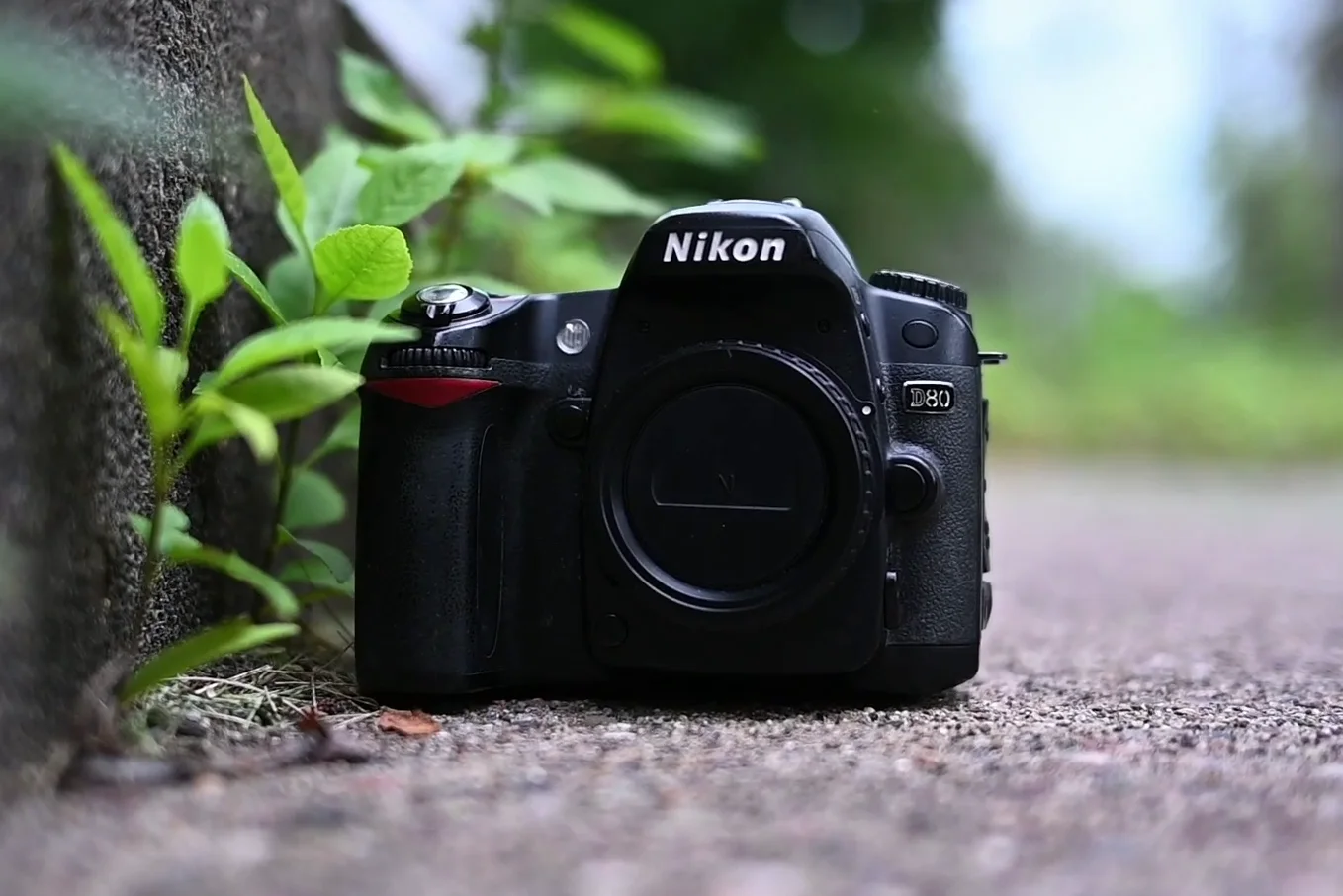
In a world obsessed with 8K video, AI autofocus that tracks bird eyes from a mile away, and sensors with more megapixels than most computers can handle, picking up a camera from 2006 feels like an act of rebellion. It’s a step back to a simpler time.
I’ve recently spent some time revisiting the Nikon D80, a DSLR that was released when flip phones were still cool and social media barely existed. Why? Because there is a growing movement in the photography community that values “character” over “clinical perfection.” And let me tell you, after shooting with the D80 in 2024, I’m convinced this might be the absolute sweet spot for anyone wanting to learn photography or capture images with a soul—without breaking the bank.
This isn’t just a trip down memory lane; it’s a look at why an 18-year-old camera might just be the creative tool you’ve been looking for.
The “Golden Era” of Nikon DSLRs
To understand the Nikon D80, you have to look at where it came from. Released in August 2006, this camera sits in a unique position in Nikon’s lineage. It was the successor to the D70s and borrowed heavily from the semi-pro D200.
Back in the day, this was the camera to have. It struck a perfect balance between the entry-level D50 and the professional D200. It wasn’t as bulky as the pro bodies, but it didn’t feel like a toy either. Holding it today, that balance still holds true. It fits naturally in the hand—substantial enough to balance a decent lens, but light enough to carry around on a photowalk all day.

If you are a collector of older DSLRs or just someone who appreciates good industrial design, the D80 represents a peak moment in Nikon’s “prosumer” ergonomics. It just feels right.
The Secret Sauce: That 10.2 MP CCD Sensor
Let’s address the elephant in the room: 10.2 Megapixels.
In 2024, your smartphone probably has more megapixels. But in photography, not all pixels are created equal. The Nikon D80 uses a CCD (Charge-Coupled Device) sensor, specifically a DX-format crop sensor.
Why does this matter? Most modern cameras use CMOS sensors. While CMOS is faster and better in low light, many photographers argue that CCD sensors render colors differently. There is a “thickness” to the color, a certain film-like organic quality that is hard to replicate with modern digital sensors without hours of post-processing.
Color Science and Image Quality
When you look at the files coming out of the D80, especially the reds and skin tones, there is a vibrancy and warmth that feels nostalgic. The images don’t look overly sharpened or “digital.”
I found that when reviewing images on a computer, the colors were surprisingly accurate to what I saw in real life, but with a pleasing aesthetic that you usually have to apply filters to achieve on newer gear. If you shoot at ISO 100 or 200 in good light, the D80 produces results that hold up incredibly well, even today.

Performance: Limitations as Features
Using an 18-year-old camera requires a shift in mindset. You aren’t going to be shooting sports at 20 frames per second, and you certainly aren’t going to be filming 4K vlogs.
The Specs Breakdown
- Autofocus: It sports 11 AF points. By modern Sony or Canon mirrorless standards, that sounds laughable. But in practice? It’s solid. The center point is reliable, and for static subjects or moderate movement, it locks on just fine.
- Speed: It shoots at 3 frames per second (FPS). This effectively rules out high-speed sports or erratic wildlife photography. It forces you to be more deliberate, to time your shots, rather than “spraying and praying.”
- ISO Capabilities: The range is 100-1600 (boostable to 3200). Here is the interesting part: The noise. On modern cameras, digital noise looks like ugly, colored confetti. On the Nikon D80, the high ISO noise looks remarkably like film grain. Shooting at ISO 800 or 1600 gives black and white photos a gritty, street-photography aesthetic that is genuinely beautiful.
Missing Features?
No video. No Bluetooth. No Wi-Fi. No GPS.
Is this a problem? I argue it’s a benefit. This is a photographer’s camera. It removes the distractions. You pick it up to take photos, check your exposure on the top LCD panel (a feature many modern cameras have sadly dropped), and focus on the art of composition.

The “Screw Drive” Advantage
One of the biggest financial reasons to buy a Nikon D80 in 2024 is the lens mount. Unlike the cheaper D40 or the later D3000/D5000 series, the D80 has a built-in focus motor (often called the screw drive).
This means you can use Nikon’s vast back-catalog of AF-D lenses. These lenses are optically fantastic but rely on the camera body to turn the focus mechanism. Because newer entry-level Nikons can’t autofocus these lenses, they are dirt cheap on the used market.

You can pick up a legendary 50mm f/1.8D for under $80 (sometimes even $50). Pair that with a D80 body that you bought for $80-$100, and you have a professional-grade portrait setup for less than the price of a kit lens.
Troubleshooting the “Err” Message
It wouldn’t be a fair review without mentioning the infamous “Err” (Error) message that plagues cameras of this era. If you pick up a used D80 and see this flashing on the top LCD, don’t panic immediately.
It usually boils down to two things:
1. Dirty Contacts: Oxidation on the lens mount or the lens itself. A quick wipe with a microfiber cloth and some contact cleaner usually fixes this.
2. The Battery: Old Lithium-Ion batteries lose voltage stability over 18 years. Often, the camera throws an error simply because the battery is dying or is a cheap third-party replacement. Investing in a fresh battery often solves the glitchiness.
Also, be aware of the shutter mechanism. These cameras are workhorses, but they are old. Check the shutter count if you can, though for the price, it’s often worth the gamble.
Who is the Nikon D80 For in 2025?
We are seeing a resurgence of “digicams” and early 2000s tech among Gen Z and younger photographers. The D80 fits perfectly into this trend, but offers significantly higher quality than a compact point-and-shoot.
- For Students: It is the perfect learning tool. It has full manual controls, forces you to understand exposure triangles, and is cheap enough that if you drop it, it’s not a tragedy.
- For Hipsters & Artists: If you want that CCD “film look” straight out of the camera without buying expensive film rolls and paying for developing, this is your answer.
- For Dads/Moms: If you just want nice photos of the family and are tired of the “smartphone look,” the skin tones from this camera are superior to almost any phone AI processing.
Conclusion: A $100 Masterpiece
When released, the Nikon D80 cost nearly $1,000 (roughly $1,500 adjusted for inflation today). Now, you can find them for the price of a nice dinner out.

Does it have its flaws? Sure. The shutter maxes out at 1/4000th, it’s slow, and the LCD screen resolution is low by modern standards. But the images it produces have heart.
If you are tired of the clinical, over-sharpened look of modern sensors and want to reconnect with the joy of taking pictures, the Nikon D80 is a hidden gem waiting to be rediscovered. It proves that you don’t need the latest gear to be a great photographer; you just need a tool that inspires you to shoot.
My recommendation: Buy the body, grab a 50mm f/1.8D, set the ISO to 400, and go shoot the sunset. You’ll understand the hype immediately.