Let’s be real for a second. If you’ve walked into a camera store recently or browsed online retailers, you’ve probably felt that sticker shock. With manufacturing shifts and potential tariffs on the horizon, the price of brand-new camera bodies and lenses—especially those not made in the USA—is climbing. For a beginner or a budget-conscious hobbyist, the barrier to entry feels like it’s getting higher every day.
But here is the secret that marketing departments don’t want you to know: Cameras don’t expire.
A camera that took award-winning photos in 2012 can still take award-winning photos in 2025. Light physics haven’t changed. The used DSLR market right now is an absolute goldmine. We are seeing legendary, professional-grade bodies hitting rock-bottom prices, often under $150.
I’m not talking about junk cameras that are barely holding together. I’m talking about solid, high-performance machines that produce image quality that still rivals entry-level mirrorless cameras costing ten times as much. If you are willing to forego the latest AI autofocus and 4K 120fps video, you can build a professional-grade kit for the price of a cheap point-and-shoot.
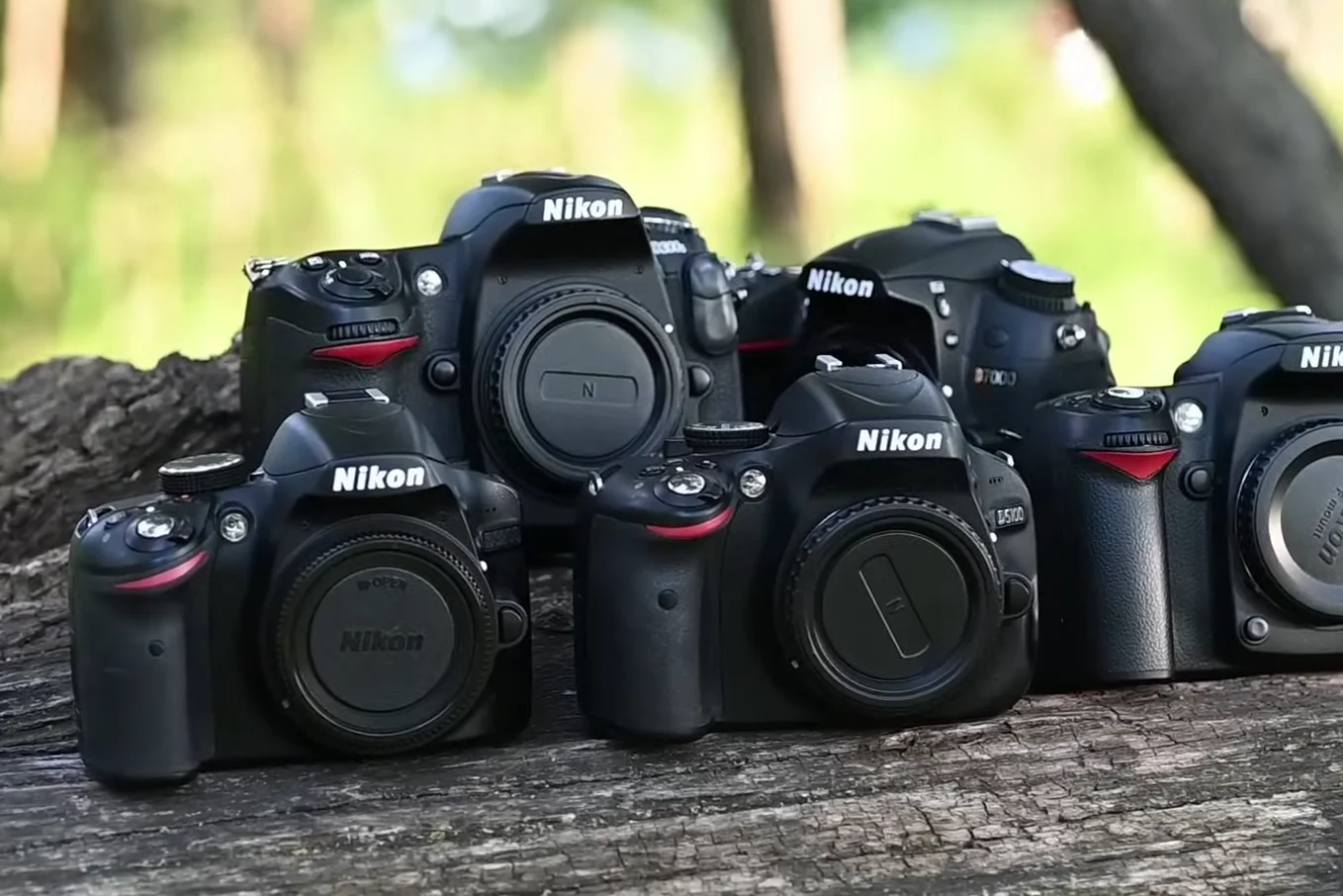
Today, we are diving deep into five incredible Nikon DSLRs that you can snag for under $150. Whether you are a student, a vlogger on a budget, or an aspiring sports photographer, there is a “beast” on this list for you.
If you are brand new to photography—I mean, you’ve never moved that dial off “Auto”—the Nikon D3200 is, hands down, one of the best places to start. You can often find these bodies floating around for about $100-$110, leaving you cash to spare for a decent lens.
The Nikon D3200 packs 24 megapixels into a body that costs less than a tank of gas.
Why It’s fantastic
Despite its age, the D3200 rocks a 24-megapixel sensor. To put that in perspective, that is the same resolution as many $2,000 cameras released today. The detail is rich, the colors are vibrant, and you have plenty of room to crop your photos without losing quality.
But the killer feature here is the Guide Mode. Think of it as having a photography tutor built right into the LCD screen. It doesn’t just change settings for you; it explains why it’s changing them. It walks you through scenarios like “Capture reds in sunsets” or “Freeze motion (people).” It’s invaluable for learning the exposure triangle without feeling overwhelmed.
It is also incredibly small and light. If you want a camera for travel or hiking that won’t break your back (or your bank account if you drop it), this is the one.
The Compromises
At this price point, you lose some conveniences.
* No Internal AF Motor: This is a big one for budget hunters. The D3200 lacks the “screw drive” motor, meaning it won’t autofocus with older, cheaper Nikon “AF-D” lenses. You stick to “AF-S” or “AF-P” lenses.
* Fixed Screen: No flipping or tilting here.
* Connectivity: No Wi-Fi or Bluetooth out of the box, though you can use a cheap SD card reader dongle for your phone to transfer images instantly.
Who is this for? The absolute beginner who wants high-resolution images for portraits and travel but finds complex menus intimidating.
2. The Content Creator’s Budget Choice: Nikon D5100
Stepping up the ladder, we have the Nikon D5100. Think of this as the D3200’s sophisticated older brother. It shares the same legendary 16-megapixel sensor found in the much more expensive D7000 (which we will get to later).
The articulating screen on the D5100 makes it a surprisingly capable tool for vloggers and creative angles.
The Game Changer: The Flip Screen
The standout feature of the D5100 is the fully articulating side-flip screen. In 2025, we take this for granted, but in the budget DSLR world, this is a luxury.
* Vlogging: You can turn the screen to face you to ensure you’re in the frame.
* Creative Angles: Get low to the ground for mushroom photography or hold it high above crowds at concerts without guessing your composition.
Image Quality & Low Light
Because it shares the sensor DNA with the semi-pro D7000, the low-light performance is surprisingly robust. The dynamic range allows you to pull detail out of shadows during post-processing in ways that phone cameras simply can’t match. It shoots 1080p video, which, while not 4K, is perfectly adequate for YouTube talking heads or Instagram Reels when paired with a sharp lens.
The Compromises
The autofocus in “Live View” (using the screen) is slow. If you are vlogging, don’t expect it to track your eye like a modern Sony. You’ll need to be patient or use manual focus. It also lacks a touchscreen, so you’ll be navigating menus with buttons.
Who is this for? Vloggers, YouTubers, and creative photographers who need flexibility in their shooting angles without spending $600 on a mirrorless body.
3. The Professional Tank: Nikon D300s
Now we are entering “Heavy Metal” territory. The Nikon D300s wasn’t built for hobbyists; it was built for working pros who needed a camera to survive war zones and sidelines. It is significantly larger and heavier than the previous two, and that’s a good thing.
Built like a tank: The D300s offers weather sealing and rugged durability that modern plastic cameras can’t touch.
Built for Speed and Abuse
When you pick up a D300s, you feel the magnesium alloy chassis. It’s weather-sealed. It feels like a weapon.
* 7 Frames Per Second (FPS): This is a machine gun. If you are shooting kids’ soccer games, motorsports, or birds in flight, that high burst rate helps you nail the exact moment of action.
* Dual Card Slots: A pro feature that saves your bacon if one SD card corrupts.
* The AF Screw Drive: This is huge. The D300s has a motor inside the body that drives autofocus on vintage Nikon lenses. This opens up a catalog of 30+ years of cheap, high-quality glass that the D3200 and D5100 can’t use fully.
The “Pro” Learning Curve
The D300s doesn’t hold your hand. There is no “Guide Mode.” It has external buttons for almost every setting (ISO, White Balance, Quality), which is faster for pros but confusing for newbies. Also, do not buy this for video. The video autofocus is virtually non-existent and the quality is dated. This is a photographer’s camera.
Who is this for? The aspiring sports or wildlife photographer who needs durability, speed, and cheap telephoto lens compatibility.
4. The Legend: Nikon D90
The Nikon D90 holds a special place in history. It was the first DSLR to ever shoot video (720p), but its legacy is in its ergonomics and still image quality. It sits perfectly in the “Goldilocks” zone between the entry-level D5100 and the pro-level D300s.
The D90 is an ergonomic masterpiece, offering dual command dials for complete manual control.
The Perfect Learning Tool
Why is the D90 still recommended in 2025? Control.
Unlike the entry-level cameras that force you to dig through menus to change aperture or shutter speed, the D90 features dual command dials (one under your thumb, one under your index finger). This allows you to adjust exposure settings instantly without taking your eye off the viewfinder.
If you want to truly learn photography—manual mode, mastering light—this physical interface is superior to touchscreens. It builds muscle memory.
It also features the internal focus motor (screw drive), just like the D300s, allowing you to use those thrifty vintage lenses. The 12-megapixel sensor produces a very distinct, filmic look that many photographers actually prefer over modern, clinically sharp sensors.
The Compromises
It shows its age in resolution (12MP is on the lower side, though fine for social media and 8×10 prints) and ISO performance. It gets grainy faster in the dark compared to the D7000.
Who is this for? The student of photography who wants to master manual controls and access cheap vintage lenses without the bulk of the D300s.
5. The Value King: Nikon D7000
If I had to pick just one camera from this list to use for the next year, it would be the Nikon D7000. It is widely considered one of the best value propositions on the used market today. You can find these in excellent condition for around $150, sometimes even less.
The Nikon D7000 offers the perfect balance of resolution, dynamic range, and professional features.
Why It’s Number One
The D7000 effectively combines the best traits of the previous cameras into one package.
1. The Sensor: It uses the same 16.2MP sensor as the D5100 but with better processing. The dynamic range is legendary; you can recover incredible amounts of detail from underexposed shots.
2. The Build: It has a magnesium alloy top and back covers, making it weather-resistant and durable, though slightly lighter than the D300s.
3. The Features: It has dual SD card slots, a 100% viewfinder coverage (what you see is what you get), and 6 FPS shooting.
4. Legacy Compatibility: Yes, it has the screw drive motor. You can slap on a $50 Nikon 50mm f/1.8D lens and have a professional portrait setup for $200 total.
The small screw drive coupling (bottom left of mount) allows the D7000 to autofocus with decades of affordable Nikon AF-D lenses.
Low Light Performance
This is where the D7000 leaves the D90 and D300s in the dust. You can comfortably shoot at ISO 1600 or even 3200 in a pinch. For concert photography, indoor events, or moody street photography, this sensor holds up incredibly well against modern standards.
The Compromises
The menu system is dense. Nikon packed a lot of tech into this body, and it can take a weekend to really customize it to your liking. Video is okay (1080p 24fps), but again, don’t rely on the autofocus for video.
Who is this for? Everyone. It’s the perfect backup camera for pros, the perfect learning camera for students, and a capable workhorse for budget semi-pros.
The Verdict: Which One Should You Buy?
Choosing between these five comes down to what you want to shoot.
Choose the D3200 if you want the smallest, lightest package and need the “Guide Mode” to teach you the ropes.
Choose the D5100 if you need a flip screen for angles or video work.
Choose the D300s if you plan on dropping your camera in the mud or need high-speed shooting for sports.
Choose the D90 if you want the cheapest entry point into “dual dial” manual control ergonomics.
Choose the D7000 if you want the best all-arounder. It gives you the weather sealing, the lens compatibility, the dynamic range, and the controls all in one package.
A Note on Lenses
The beauty of buying Nikon is the F-Mount. Since 1959, Nikon used largely the same mount. With cameras like the D90, D300s, and D7000, you can buy older “AF-D” lenses. These are optically fantastic but much cheaper than modern lenses because they rely on the camera body to focus them.
* Recommendation: Grab a 50mm f/1.8D (often ~$60) or a 35mm f/1.8G DX (~$100). Pair that with one of these bodies, and you have a kit capable of producing magazine-quality images.
Don’t let the shiny allure of new $2,000 mirrorless cameras fool you. Photography is about light, composition, and the moment. These $150 DSLRs are more than capable of capturing all three.