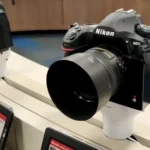
Let’s be honest for a second. In the world of photography, the “nifty fifty” (50mm lens) is practically a religion. It’s the first prime lens we’re told to buy, and for good reason. But what if I told you that moving just 5 millimeters back could change your entire perspective? And what if that lens came with a feature almost no other fast prime in its class has?
I’m talking about the Tamron SP 45mm f/1.8 Di VC USD.
I’ve spent a considerable amount of time with this glass, specifically on Nikon bodies like the D300s and the full-frame D3, and I have to say: this lens is a disruptor. It’s not just “good for the price”; it’s a piece of optical engineering that challenges the titans of the industry. Even in 2024 and beyond, this lens holds its ground remarkably well.
In this deep dive, I want to share my real-world experience with the Tamron 45mm, why that odd focal length actually makes sense, and why the Vibration Compensation (VC) is a total game-changer for handheld shooters.
If you’ve been in the photography game for a decade or more, you remember the “old” Tamron. They made decent budget lenses, but they felt plasticky. The introduction of this 45mm lens (along with its sibling, the 35mm f/1.8 VC) marked a massive shift in the company’s philosophy. “SP” stands for Super Performance, and for the first time, it really felt like they meant it.
The minimalist, premium design of the SP series marked a new era for Tamron.
The build quality here is stellar. It has a sleek, matte black finish that feels premium in the hand. It’s not a lightweight, toy-like lens. It has heft, and in the world of optics, heft often translates to quality glass elements. It features a 67mm filter thread, which is a fairly standard size, making filters affordable and accessible.
But beyond just looking pretty, it’s functional. The lens is weather-sealed, which gives you that extra peace of mind when you’re out shooting street photography and the sky decides to open up on you.
You might be asking, “Why 45mm?”
It sounds trivial, but 45mm offers a slightly wider field of view that feels arguably more natural to the human eye than a strict 50mm. Sometimes, a 50mm can feel a tiny bit tight when shooting indoors or trying to capture environmental portraits. That extra breathing room with the 45mm makes composition just a little bit easier without introducing the distortion you might get from a 35mm.
It occupies a sweet spot. It’s the Goldilocks focal length—not too wide, not too tight.
Here is where this lens leaves the Nikon 50mm f/1.8G (and honestly, even the f/1.4G) in the dust. The Tamron 45mm features Vibration Compensation, or VC.
The VC switch is the magic button that separates this lens from standard fast primes.
Usually, we see stabilization in zoom lenses or macro lenses. Putting it in a fast prime with a maximum aperture of f/1.8 seems redundant to some, but in practice, it opens up a new world of low-light possibilities.
The old rule of thumb is that your shutter speed should match your focal length (so, 1/50th of a second for a 50mm lens) to avoid handshake blur. With the VC on this Tamron, you can shatter that rule.
I’ve successfully shot handheld at 1/5th of a second and gotten tack-sharp results. That is insane.
This means you can keep your ISO low (for cleaner images) and stop down your aperture slightly (for more depth of field) even in dim lighting conditions, and still get a sharp shot without a tripod. For wedding photographers or night street photographers, this feature alone justifies the price of admission.
I generally leave the VC ON all the time, especially for low-light situations. It stabilizes the viewfinder image, making composition easier, and ensures micro-jitters don’t ruin a high-resolution shot.
Let’s get technical for a moment. How does the glass actually perform?
Wide Open (f/1.8): It is incredibly sharp. Many fast primes suffer from “dreamy” (read: soft) rendering wide open, requiring you to stop down to f/2.8 to get real sharpness. The Tamron 45mm is usable and sharp right out of the gate at f/1.8.
The Aperture Range: It goes from a fast f/1.8 down to a minimum of f/16.
The aperture blades create smooth bokeh, while the front element coating helps with flare.
The bokeh (background blur) is smooth and creamy. The transition from the sharp subject to the out-of-focus background is gentle, which is exactly what you want for portraiture.
The Elephant in the Room: Chromatic Aberration
No lens is perfect. If I had to nitpick—and really, this is just nitpicking—the Tamron 45mm can exhibit some Chromatic Aberration (color fringing), particularly purple or green fringes in high-contrast areas (like tree branches against a bright sky).
Is it a dealbreaker? Absolutely not. If you are shooting in RAW (which you should be), this is corrected with a single click in Lightroom or Photoshop. It’s prominent if you look for it, but easily managed in post-production.
I own the Nikon 50mm f/1.8G. It’s a fantastic, lightweight, and cheap lens. But when I put it next to the Tamron, the difference is stark.
The Tamron is significantly bulkier, but that bulk comes with better optics and stabilization.
Size & Weight: The Tamron is significantly bulkier and heavier. For some, this is a con. However, on pro-bodies like a Nikon D3, D850, or even a D500, the Tamron actually balances better. The tiny Nikon 50mm feels unbalanced on a large body. The Tamron feels like a serious tool.
Sharpness: In my experience, the Tamron resolves detail better than the Nikon 50mm, especially towards the edges of the frame.
Technology: The Nikon 1.8G has no stabilization. The Tamron does.
If you are a hiker counting every gram, the Nikon wins. For everyone else who values image quality and versatility, the Tamron takes the crown.
The lens uses Tamron’s USD (Ultrasonic Silent Drive) motor. In practice, I’ve found the autofocus to be snappy and accurate.
While the manual focus ring is nice and smooth—much better than the gritty feel of cheaper lenses—I rely on Autofocus 99% of the time. Whether on my D80 back in the day or a D3 now, it locks on.
I know some purists prefer manual focus, but when you have a reliable AF system like this, why struggle? The focus is internal, meaning the front element doesn’t rotate, which is great if you’re using a polarizing filter.
Here is the best part. Because this lens sits in that weird “45mm” category and isn’t a first-party Nikon or Canon lens, it often flies under the radar on the used market.
Keep an eye on the used market; this lens is often undervalued by sellers.
I managed to snag my copy on Facebook Marketplace for around $160. Yes, it had some cosmetic blemishes—some of the lettering was rubbing off—but the glass was pristine and the mechanics were flawless.
For $160 (or even $250-$300), getting a weather-sealed, stabilized, razor-sharp prime lens is practically theft. It offers a value proposition that is hard to beat.
If you are stuck deciding between a 35mm and a 50mm, or if you are looking to upgrade your “plastic fantastic” nifty fifty to something more professional, the Tamron SP 45mm f/1.8 Di VC USD is the answer.
Cons:
* Noticeable Chromatic Aberration (fixable).
* Heavier and larger than standard 50mm lenses.
Even for close-up detail shots in lower light, the VC keeps things crisp.
I would choose this lens over the Nikon 50mm f/1.8G any day of the week. The weight gives me confidence, the sharpness makes my portraits pop, and the stabilization saves me when the sun goes down. It’s a lens that doesn’t just sit on the shelf; it begs to be used.
If you can find one used, don’t hesitate. It might just become your favorite lens cap.