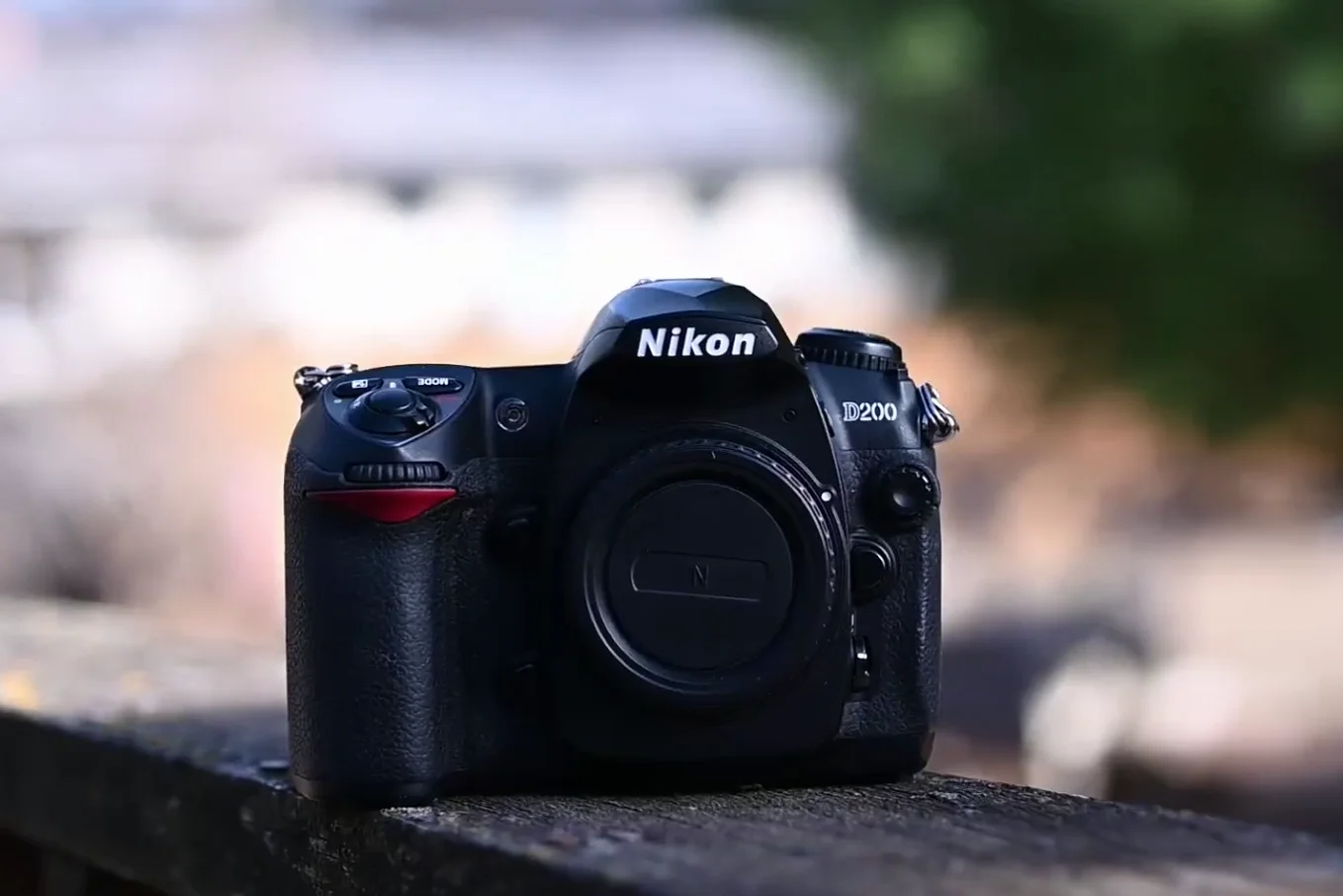
It’s hard to believe, but we are looking at a piece of technology that hit the shelves in November 2005. That’s right, the Nikon D200 is officially a 20-year-old camera. In the fast-paced world of digital imaging, two decades is essentially an eternity. It’s the difference between a flip phone and the latest iPhone Pro.
Yet, here we are in 2025, and there is a massive resurgence of interest in this chunky, black magnesium brick. Why? Is it just nostalgia, or is there actually some magic left in this old sensor?
Back when it launched, the D200 commanded a price tag of $1,800. Adjusted for inflation, that’s roughly $3,300 today. It was a serious tool for serious photographers, bridging the gap between the enthusiast D70 and the professional D2 series. Today, you can pick one up for the price of a fancy dinner date—often under $100.
I’ve been shooting with the D200 recently to see if it’s just a paperweight or if it holds the title for the best “vintage” digital camera you can buy. Spoiler alert: It might just be the latter.
Let’s address the elephant in the room immediately. Why buy a 10.2-megapixel camera when your phone has 48 megapixels? The answer lies in three letters: CCD.
The legendary 10.2MP CCD sensor is the main reason photographers are flocking back to this camera.
Modern cameras use CMOS sensors. They are efficient, great in low light, and have high dynamic range. However, the D200 uses a CCD (Charge-Coupled Device) sensor. For the uninitiated, CCD sensors render images differently. There is a thickness, a richness to the color science that is often described as “film-like” or “analog.”
The D200 doesn’t try to be clinically perfect. Instead, it produces images with distinct, punchy reds and deep, natural greens right out of the camera. The 10.2 megapixels are more than enough for social media (Instagram, Facebook) and even decent-sized prints. We often overestimate how much resolution we actually need.
The “Film Grain” Factor
One of the most surprising aspects of using the D200 today is its high ISO performance. Now, don’t get me wrong—compared to a modern Nikon Z series, the D200 is terrible in low light on paper. It goes from ISO 100 to 1600 (with a boost to 3200).
However, the quality of the noise is what makes it special. Modern digital noise often looks like ugly color blotches. The noise on the D200 looks remarkably like film grain. It’s monochromatic and organic. Shooting black and white at ISO 1600 on this camera yields results that look strikingly like Tri-X 400 film pushed a couple of stops. It’s an aesthetic choice, not a technical flaw.
At high ISOs, the D200 produces a monochromatic ‘noise’ that mimics analog film grain rather than digital artifacts.
Built Like a Tank (Literally)
When you pick up a D200, the first thing you notice is the density. This is not a plastic toy. It features a magnesium alloy chassis that feels incredibly premium. It harkens back to an era where cameras were built to survive war zones.
The ergonomics are quintessentially Nikon. If you’ve used a D300, D700, or even a D850, you’ll feel right at home. It fits perfectly in the hand. However, because these bodies are two decades old, you have to watch out for the dreaded “sticky rubber” syndrome, where the grips start to degrade or peel off. It’s a common cosmetic issue, but it doesn’t affect the performance.
The robust magnesium alloy build and professional button layout make the D200 feel like a serious tool in hand.
It’s also worth noting the viewfinder. It’s a pentaprism, not a pentamirror, making it big and bright. Looking through optical glass is a refreshing experience if you’ve been staring at electronic viewfinders (EVFs) or phone screens all day.
Specifications: A Reality Check
To enjoy the D200 in 2025, you need to manage your expectations regarding specs. Here is what you are working with:
Autofocus: 11 AF points. It sounds ancient compared to the hundreds of points on mirrorless cameras, but the central cross-type point is surprisingly sticky and reliable, even in lower light.
Speed: 5 frames per second. It’s not a machine gun, but it’s fast enough for street photography and casual portraits.
Storage: Compact Flash (CF) cards. You will need a specialized card reader to get photos onto your computer.
Screen: A 2.5-inch LCD. By modern standards, it’s low resolution. It’s fine for checking the histogram and composition, but don’t trust it for critical sharpness or color accuracy—trust the sensor data instead.
Connectivity: No Wi-Fi. No Bluetooth. You are shooting “offline.”
You will need to invest in a CF card and a reader, as this camera predates SD card standardization in pro bodies.
The “No Video” Advantage
The D200 does not shoot video. It doesn’t even have Live View. You cannot compose images using the screen; you must use the viewfinder.
For many of us, this is a massive pro, not a con. It removes distractions. When you pick up the D200, you are there to take photographs. There is no temptation to switch to video mode, no menu diving for frame rates or log profiles. It is a pure photography experience that forces you to slow down and engage with your subject.
The Secret Weapon: Lens Compatibility
One of the biggest reasons to buy a D200 today is the lens ecosystem. The D200 features a built-in focus motor (the “screw drive”).
This means it is fully compatible with Nikon’s vast back-catalog of AF-D lenses. These lenses are often optically fantastic, built with metal, and are dirt cheap on the used market because they don’t autofocus on entry-level Nikon DSLRs (like the D3000 or D5000 series) or FTZ adapters without motors.
The screw-drive motor allows you to use vintage AF-D lenses, like this 70-210mm f/4, providing incredible value.
For this review, I paired the camera with:
1. Tamron 17-50mm f/2.8: A sharp, versatile zoom.
2. Nikon 50mm f/1.4D: A classic portrait lens that renders beautifully on the CCD sensor.
3. Nikon 70-210mm f/4: An old “push-pull” zoom that creates lovely background separation and sharpness for almost no money.
With the crop factor (1.5x), your 50mm acts like a 75mm portrait lens, which is a sweet spot for headshots.
Image Quality in 2025: Does it Hold Up?
The short answer is yes. The long answer is that it holds up if you expose correctly.
CCD sensors are notorious for having less dynamic range than modern CMOS sensors. You cannot underexpose by 5 stops and expect to recover the shadows without penalty. You have to shoot like you are shooting slide film—nail the exposure in-camera.
When you do, the results are stunning. Skin tones look natural, not waxy. Foliage looks lush. There is a depth to the images that feels tactile.
Straight out of camera JPEGs show accurate colors and a surprisingly organic rendering that many modern cameras struggle to replicate.
Dynamic Range Surprise
Despite the reputation of older sensors struggling with dynamic range, I found the D200 surprisingly capable. You can recover shadows reasonably well, certainly better than a smartphone. But again, the charm here isn’t the technical perfection; it’s the character.
Who is the Nikon D200 For?
This camera occupies a very specific niche in 2025.
1. The Student / Beginner:
If you want to learn real photography—exposure triangles, metering, composition—this is arguably a better learning tool than a modern mirrorless camera. It doesn’t hold your hand. It forces you to learn the mechanics, and at $80-$100, the barrier to entry is non-existent.
2. The “Film Look” Chaser:
Film photography has become prohibitively expensive. A roll of Portra 400 plus development can cost $30-$40. The Nikon D200 gives you 80-90% of that analog feel for a one-time purchase price equal to about three rolls of film. It’s the “poor man’s Leica.”
3. The Collector:
The D100, D200, and D300 represent a golden era of Nikon design. They look great on a shelf, but they are even better in the field.
For under $100, the Nikon D200 offers a build quality and image aesthetic that punches way above its price class.
Final Verdict
The Nikon D200 is not a camera you buy for specs. You don’t buy it for 4K video, eye-tracking autofocus, or 50,000 ISO capability. You buy it for the soul.
It brings the fun back into photography. The click of the shutter is mechanical and satisfying. The colors require very little editing. The limitations of the camera force you to be more creative, to look for better light, and to compose more carefully.
In a world of AI-generated imagery and computational photography where phones make night look like day, the Nikon D200 offers something rare: honesty. It captures light exactly how the old CCD sensor sees it—imperfect, grainy, but utterly beautiful.
If you have a hundred bucks burning a hole in your pocket and you want to experience digital photography’s “vintage” era, grab a D200 before the secret gets out and prices skyrocket. It might just become your favorite camera to carry around.