If you’ve been hanging around photography forums or YouTube channels lately, you might have noticed a resurgence of interest in older DSLRs. There’s something undeniable about the tactile feel of a chunky camera body, the mechanical slap of a mirror, and the hunt for that “film-like” aesthetic without the recurring cost of actual film.
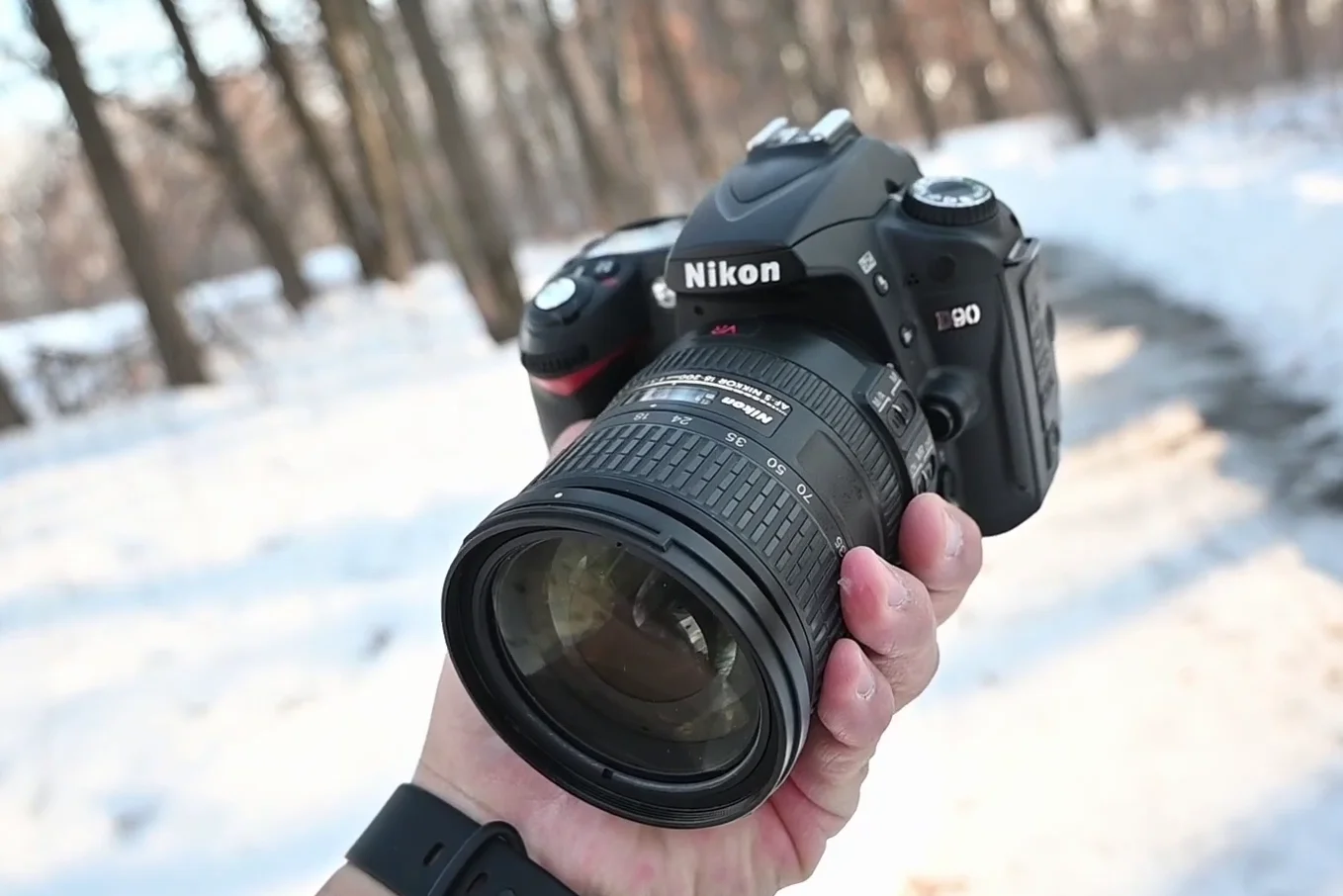
Today, we are revisiting a legend. A camera that, for many of us, was the “gateway drug” into the world of semi-professional photography: The Nikon D90.
Released way back in 2008, the D90 is ancient in tech years. But does age make it obsolete, or does it turn it into a classic? Based on recent field tests and a heavy dose of nostalgia, here is why the Nikon D90 might just be the best $150 you can spend on photography gear in 2023 and beyond.
To understand the D90, you have to understand where it sits in history. Before this camera, you generally had two choices: expensive professional bodies (like the D300) or plasticky entry-level bodies (like the D40/D60). The D90 bridged that gap perfectly.
It was robust, weather-sealed enough for daily use, and introduced features that changed the game. For me, and many others, this was the camera we sold our starter kits for. It felt like “arriving” in the world of serious image-making.
The button layout and LCD screen were inherited from professional models like the D300.
The Specs: Do They Hold Up?
Let’s look at the cold, hard numbers. On paper, a 2008 camera should be laughable today. But in practice? It’s a different story.
Sensor: 12.9 Megapixel DX (APS-C) CMOS sensor.
ISO Range: 200–3200 (Expandable to 6400).
Speed: 4.5 frames per second.
Display: 3-inch, 920k-dot LCD.
Is 12 Megapixels Enough?
In an era of 45MP mirrorless monsters, 12MP sounds tiny. However, unless you are printing billboards, 12MP is arguably the sweet spot for digital storage and social media. The files are manageable, the processing is fast, and the detail is surprisingly sharp.
The “Secret Weapon”: The AF Screw Drive
One of the absolute strongest arguments for buying a D90 today is lens compatibility.
Unlike Nikon’s entry-level D3000 or D5000 series (and their modern successors), the Nikon D90 features an internal focus motor (the screw drive). This little metal screw on the lens mount allows you to use older Nikon AF-D lenses with full autofocus capabilities.
That small screw drive pin opens up a world of affordable, high-quality vintage glass.
Why does this matter? Because Nikon AF-D lenses (like the 50mm f/1.4D or the 85mm f/1.8D) are optically fantastic, built like tanks, and significantly cheaper than the newer “G” or “Z” lenses. You can build a professional-grade lens kit for a fraction of the price, simply because the D90 can drive them.
The compact 50mm f/1.4D is a perfect companion for this body.
Real-World Performance
Specs are one thing; using the camera is another. Taking the D90 out for a spin in 2023 reveals a few surprises.
1. ISO and Low Light
When this camera launched, its high ISO performance was revolutionary. By modern standards, it’s “decent.” The camera shines between ISO 200 and 800. Once you push past ISO 1600, you will see grain.
However, the noise from these older sensors often looks more like organic film grain rather than the ugly digital color noise you get from cheap modern sensors. With a fast prime lens (like that f/1.4 mentioned earlier), low-light street photography is still very achievable.
Low light performance at ISO 800 is still very usable for web and small prints.
2. Battery Life: The Energizer Bunny
If you are coming from the mirrorless world, you are used to carrying three spare batteries. The D90 laughs at that. DSLRs are efficient. Because you are using an optical viewfinder (OVF) rather than an electronic screen for composing, the battery lasts for days of casual shooting. It’s reliable, predictable, and one less thing to worry about.
3. Image Quality and Color Science
There is a subjective quality to images from this era of Nikon cameras. The colors are punchy but realistic. The skin tones are pleasing.
In the test shots with the 18-200mm VR and the 50mm Prime, the images came out sharp with excellent contrast. Whether it’s the texture of pinecones or the motion blur of a passing car, the sensor captures the “feeling” of the scene perfectly.
Even with a super-zoom lens like the 18-200mm, the 12MP sensor resolves plenty of detail.
The Downsides: Showing Its Age
It wouldn’t be an honest review without addressing the elephants in the room.
Video Recording: The D90 was actually the firstDSLR to offer video recording. But don’t get excited. It’s limited to 720p, has a 5-minute clip limit, and—crucially—has no autofocus in video mode. You have to manually focus. It’s a fun historical quirk, but don’t buy this for vlogging.
The Yellowing Screen: Many D90 units now suffer from LCD degradation where the screen takes on a yellow tint. The photos themselves are fine, but reviewing them on the back of the camera might look a bit “off.”
Ergonomics for Modern Users: If you are used to modern button layouts, some of the D90’s choices (like the ISO button placement) might feel clunky or unintuitive at first.
The Verdict: Who is this for?
If you have $600-$1000, go buy a modern mirrorless camera. But if you have $150-$200 and want to learn the art of photography? The Nikon D90 is a steal.
It forces you to learn the exposure triangle. It gives you access to cheap, professional glass. It feels great in the hand, and the battery won’t die on you halfway through a hike.
Rugged, reliable, and capable. The D90 remains a solid choice for budget-conscious photographers.
The D90 proves that great photography isn’t about the newest autofocus AI or 8K video. It’s about light, composition, and a tool that gets out of your way. Fifteen years later, the D90 is still that tool.
Pros:
* Incredible value for money (approx. $150 used).
* Access to affordable AF-D lenses.
* Great battery life.
* Classic DSLR ergonomics.
Cons:
* Video mode is archaic.
* Low light performance lags behind modern sensors.
* LCD screens are prone to aging.
Have you used the Nikon D90? Do you still have one gathering dust on a shelf? Pull it out, charge the battery, and go shoot. You might be surprised at what it can still do.