In the year 2025, the resurgence of film photography has moved past being a “hipster trend” and settled into a respected art form. However, with this popularity comes the inevitable price hike of the “big name” cameras. The Canon AE-1s and Nikon F3s of the world now command prices that can make a beginner weep.
But what if I told you there is a tank-like, fully mechanical workhorse that often outperforms its more famous rivals, yet sits quietly in the bargain bin of history?
Enter the Minolta SR-T 102.
Produced between 1973 and 1975, this camera is widely regarded by Minolta faithfuls as the pinnacle of the SR-T series. After spending significant time with this silver-and-black beauty, I’m inclined to agree. It doesn’t just take pictures; it teaches you photography.
Let’s dive deep into why this might be the best vintage SLR investment you can make today.
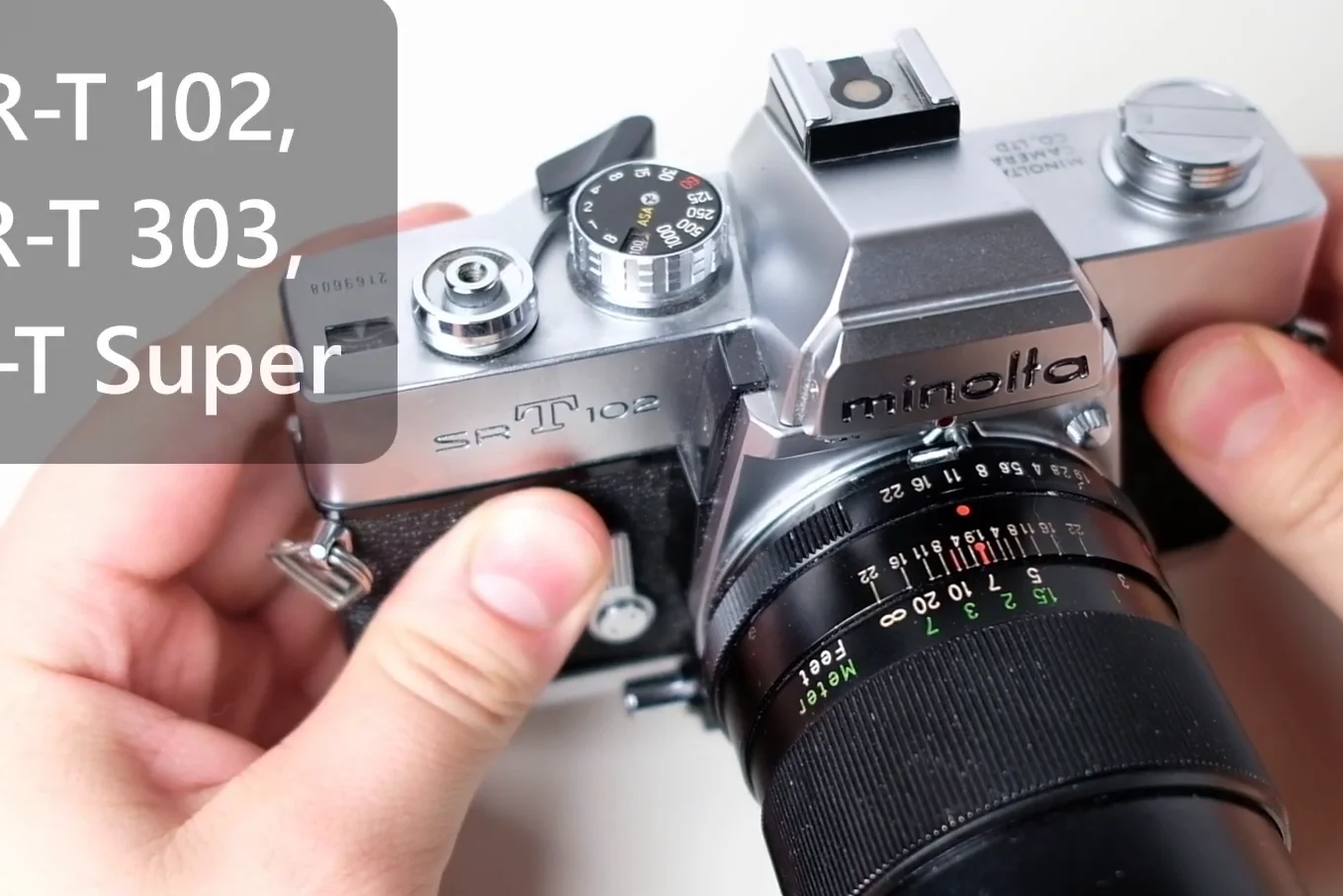
Before we get into the mechanics, let’s clear up the confusing nomenclature that plagued the 70s camera market. Depending on where you live or where your eBay find comes from, you might see this camera listed under different badges.
North America: SR-T 102
Europe: SR-T 303
Asia/Japan: SR-T Super
Whether it says 102, 303, or Super, it is the same mechanical masterpiece.
Mechanically, they are identical. They are the refined, feature-rich successors to the legendary SR-T 101. While the 101 is a classic, the 102 adds the creature comforts that make shooting in 2025 a much smoother experience.
The Viewfinder: Information Overload (In a Good Way)
If you have ever shot with older SLRs, you know the struggle of “needle chasing.” You often have to take your eye away from the viewfinder to check your aperture ring or shutter dial. It breaks your flow.
The massive upgrade in the SR-T 102 is the Full Information Viewfinder.
A rarity for the 70s: seeing your shutter speed (bottom) and aperture (top) without moving your eye.
When you look through the prism, you don’t just see your subject.
1. Right Side: You see the “match needle” metering system. A thin needle indicates the light level, and a “lollipop” circle needle indicates your settings. You simply match the lollipop to the thin needle by adjusting aperture or shutter speed. It is tactile, intuitive, and satisfying.
2. Top: The selected aperture number is visible (via a small window reflecting the lens barrel).
3. Bottom: The selected shutter speed is displayed.
This means you can compose, meter, and adjust exposure without ever losing sight of that decisive moment. In 1973, this was cutting-edge; in 2025, it’s a luxury feature that many other vintage cameras lack.
Focusing Made Easy
Another massive improvement over the older 101 is the inclusion of a split-image rangefinder in the center of the focusing screen, surrounded by a microprism collar.
If you are new to manual focus, the split image is a lifesaver. You find a vertical line in your subject, turn the focus ring until the “split” aligns, and snap. It is precise and much faster than relying on your eye’s estimation of sharpness on a matte screen.
The “CLC” Secret Sauce
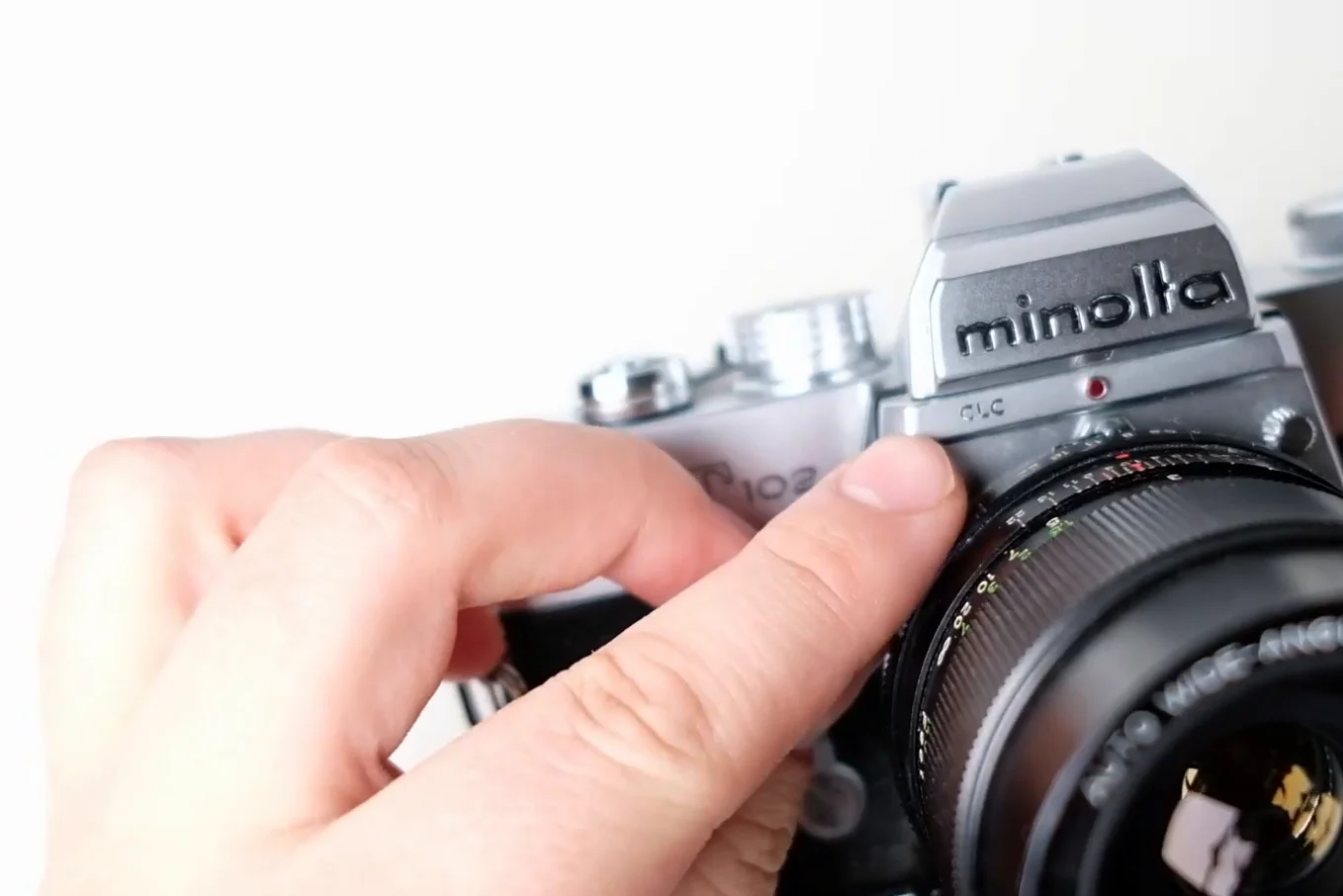
On the front of the prism, you’ll see the letters CLC. This stands for Contrast Light Compensation.
CLC Metering: Minolta’s innovative solution to high-contrast lighting scenes.
This was Minolta’s answer to tricky lighting conditions before matrix metering existed. The camera uses two CdS cells on the prism. Generally, the sky is brighter than the ground. The CLC system connects these cells in a way that prevents the bright sky from underexposing your main subject on the ground.
Does it work? surprisingly well. While it’s not as foolproof as a modern Sony A7’s metering, for a 50-year-old mechanical camera, it handles backlit landscapes with impressive accuracy.
Build Quality and Ergonomics
Holding the SR-T 102 feels like shaking hands with history. It is heavy, dense, and cold to the touch. It is constructed almost entirely of metal. This isn’t a plastic toy; it’s a precision instrument.
The layout is classic:
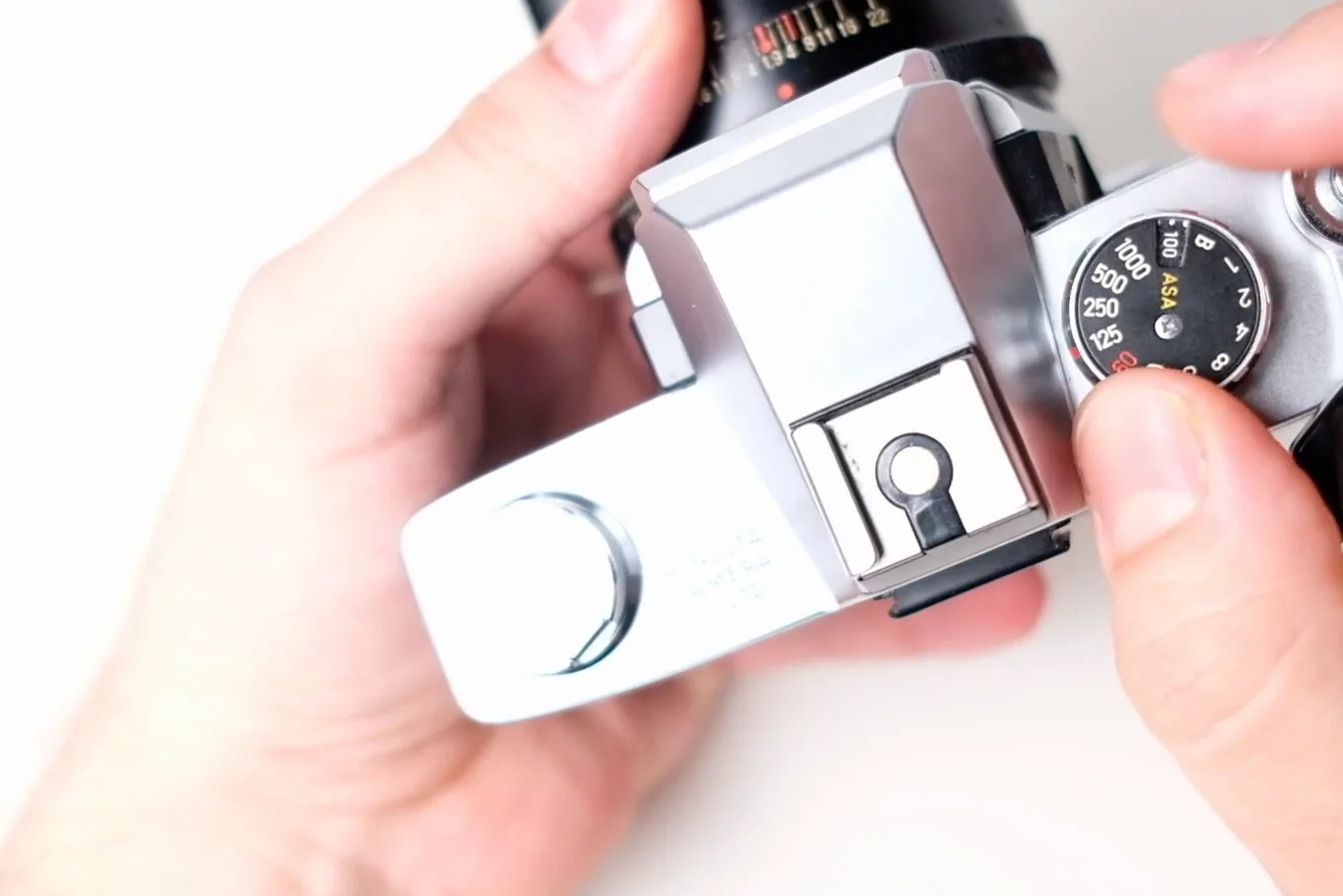
* Shutter Speed Dial: Located on the top right, ranging from 1 second to 1/1000th, plus Bulb mode.
* ISO/ASA Selector: Cleverly integrated into the shutter dial. You lift the ring and turn it to set your film speed (ranges from ISO 6 to 6400).
* Advance Lever: Smooth, with a short throw.
The shutter speed dial is tactile and crisp. Note the ISO setting integrated into the dial lift mechanism.
A nice touch regarding the “fully mechanical” nature: The battery is only for the light meter. If your battery dies mid-shoot, or if electronics fail, the shutter still fires at all speeds. You just have to use “Sunny 16” or an external light meter app on your phone. This reliability is why these cameras are still around 50 years later.
The 1.35V Voltage Elephant in the Room
We cannot talk about 1970s cameras without addressing the battery issue. The SR-T 102 was designed for 1.35V Mercury batteries (specifically the PX625).
Mercury batteries are banned (rightfully so) due to environmental toxicity.
Why is this a problem?
Modern alkaline replacements (like the PX625A) fit physically, but they output 1.5V. Because the SR-T 102 does not have a voltage regulator circuit (it relied on the mercury battery’s stable voltage), using a 1.5V battery will make the light meter inaccurate. It will usually tell you to underexpose your shot.
The battery compartment is easy to access, but finding the right voltage requires a specific purchase.
The Solutions for 2025:
1. WeinCell MRB625: These are zinc-air batteries designed to output 1.35V. They are the easiest drop-in replacement.
2. Hearing Aid Batteries + Adapter: You can use inexpensive 1.4V hearing aid batteries with a cheap brass adapter or a rubber O-ring.
3. Voltage Diode Mod: A technician can solder a diode into the camera to step down the voltage, allowing you to use modern silver oxide batteries.
To check your battery, the camera has a switch on the bottom labeled BC (Battery Check). When switched here, the meter needle in the viewfinder should drop to a specific square notch. If it hits the mark, you are good to go.
Features: More Than Meets the Eye
For a “basic” mechanical SLR, the SR-T 102 is surprisingly stacked with features that creative photographers love:
Depth of Field Preview: A button on the lens mount (often missing on lower-end models) stops the lens down to the taking aperture so you can see exactly what will be in focus. Note: The viewfinder will get darker when you do this.
Mirror Lock-Up: (Note: Some early 102 models have this, some late ones don’t). This lifts the mirror before the shutter fires, eliminating vibration for long exposures.
Multiple Exposures: The rewind button on the bottom is not just for rewinding. If you press it and crank the advance lever, the film won’t move, but the shutter cocks. This allows you to layer images on a single frame—a creative technique that is very trendy in 2025.
The front of the camera hosts the mechanical self-timer and the Depth of Field preview button.
The Lens System: MC vs. MD
The camera uses the Minolta SR mount (often referred to as MC/MD).
MC (Meter Coupled): These are the period-correct lenses for the SR-T 102. They allow for full open-aperture metering.
MD: These came later (for the XD and X-700 series). They fit and work perfectly on the SR-T 102, though they were designed for lighter, plastic-body cameras.
The lens showcased here is a Vivitar 35mm f/1.9 Auto Wide-Angle. While Minolta’s own “Rokkor” lenses are legendary for their color rendition and sharpness (and bokeh), third-party vintage lenses like this Vivitar can be hidden gems. They offer fast apertures (f/1.9 is great for low light) at a fraction of the cost.
A Note on “Radioactive” Lenses:
It is worth noting that some high-end lenses from this era (often the fast f/1.2 or f/1.4 variants) used Thorium glass elements. Over time, these can yellow (which can actually be cured with UV light), and they are mildly radioactive. As the reviewer notes, unless you are grinding the glass into a powder and snorting it, or sleeping with the lens taped to your eyeball, it is generally safe. But it’s a fun party fact to tell your friends.
The Experience
Shooting with the Minolta SR-T 102 is a sensory experience. The sound of the shutter is a distinct, metallic “CLACK” that resonates. The film advance is smooth but mechanical; you can feel the gears meshing.
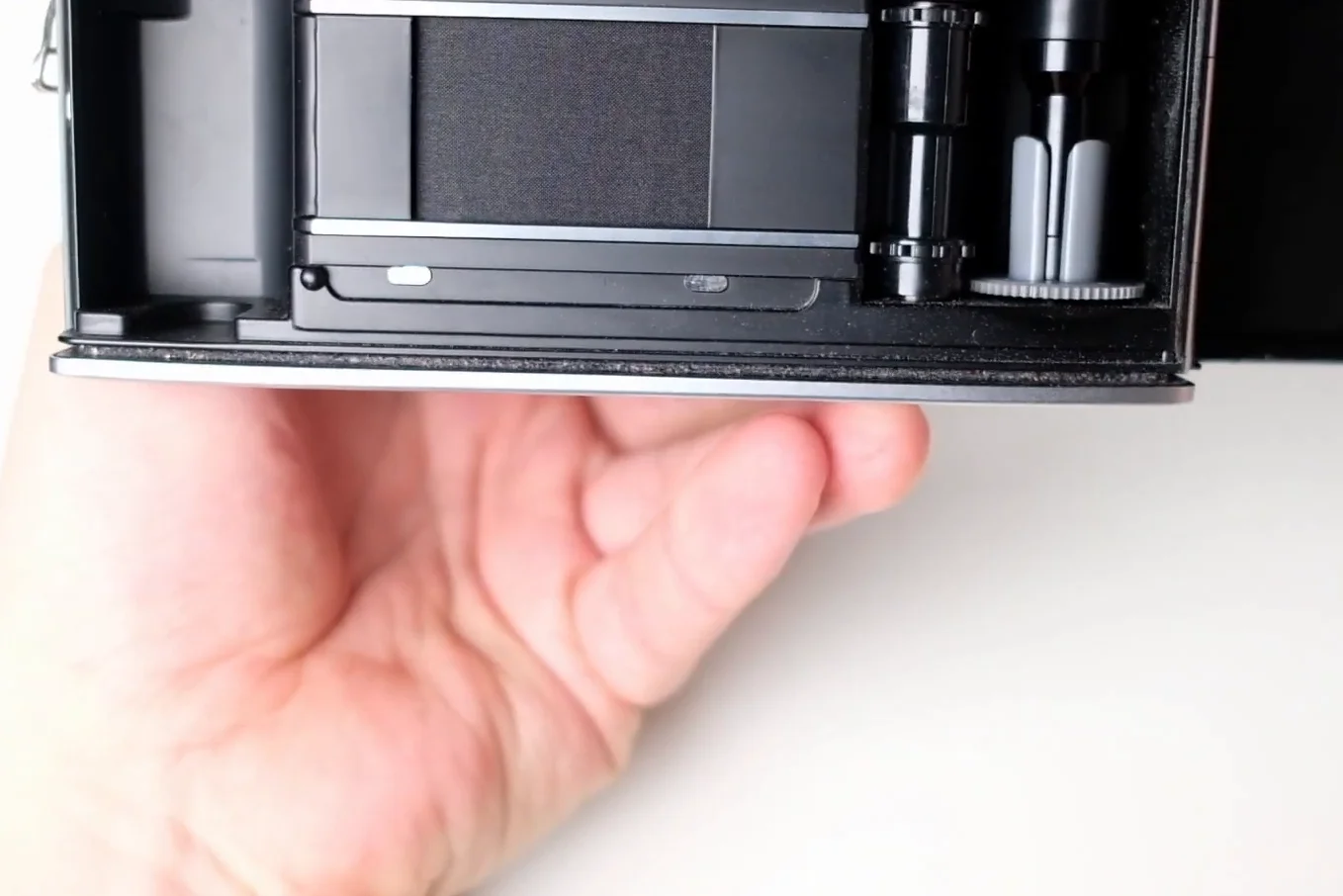
The horizontal traveling cloth shutter is robust and simple to load.
It slows you down. Unlike shooting digital, where you spray and pray, the SR-T 102 demands that you look at the light, match the needle, focus the split image, and compose with intent.
The Verdict: Buy or Pass in 2025?
If you are looking for a mechanical 35mm SLR, you are likely looking at the Canon AE-1 Program or the Pentax K1000.
I challenge you to look at the Minolta SR-T 102 instead.
Pros:
* Value: It is significantly cheaper than equivalent Canons or Nikons.
* Glass: Minolta Rokkor lenses are world-class, often rivaling Leica glass of the same era (Minolta and Leica actually collaborated later on).
* Durability: It is virtually indestructible.
* Viewfinder: Seeing shutter and aperture info is a game-changer for learning exposure.
Cons:
* Weight: It is heavy. You will notice it around your neck after a few hours.
* Battery: You need to buy specific adaptors or Wein cells.
The Minolta SR-T 102 represents a golden era of Japanese manufacturing. It doesn’t have autofocus. It doesn’t have auto-exposure. It doesn’t have Wi-Fi. It just has everything you need to take a beautiful photograph, and absolutely nothing you don’t.
If you find one in good condition, grab it. It might just be the last film camera you ever need to buy.
Have you shot with Minolta cameras? Do you prefer the tank-like build of the SR-Ts or the electronic convenience of the X-700s? Let me know in the comments below!