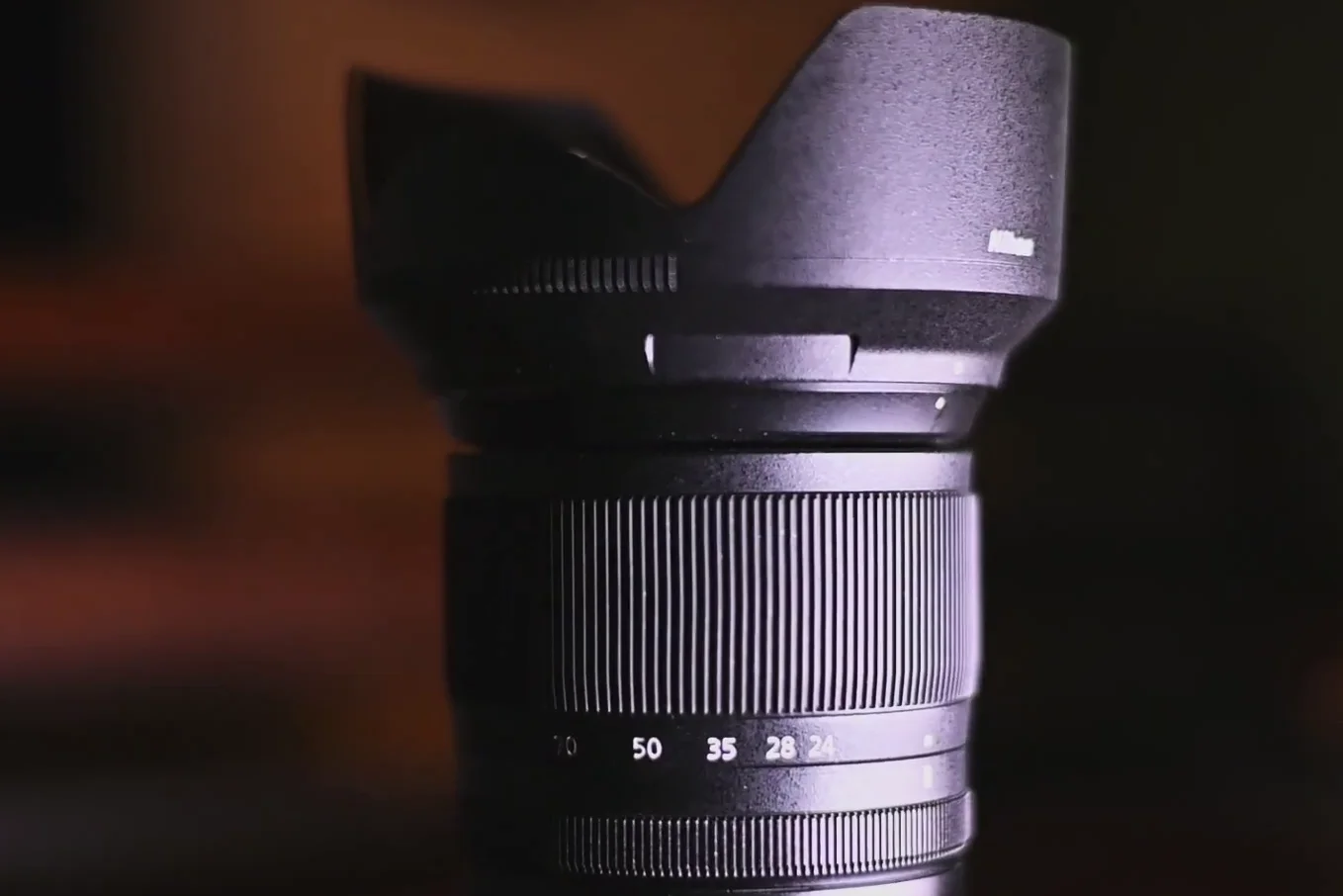
For decades, the term “kit lens” has been something of a dirty word in the photography community. It conjured up images of cheap, plastic, rattling lenses with variable apertures that you would use for a month before desperately upgrading to “real glass.”
When Nikon launched their Z series mirrorless system, they bundled the Z6 and Z7 with the Nikon NIKKOR Z 24-70mm f/4 S. Naturally, many of us were skeptical. Was this just another paperweight to toss in a drawer?
After spending a full year shooting with this lens on a Nikon Z6, covering everything from family portraits to car shows and travel, my perspective has completely shifted. If you are sitting on the fence about whether to get the kit bundle or save up for the Holy Trinity f/2.8 version, this breakdown is for you.
Let’s address the elephant in the room: build quality. When you first unbox this lens, you will notice it is lightweight. For photographers coming from the heavy, tank-like DSLRs of the past, “light” often gets misinterpreted as “cheap.”
The lens features a retractable design that makes it incredibly compact for travel.
There has been a lot of chatter online about the “plasticky” feel of modern mirrorless lenses. While it’s true that the exterior is polycarbonate, it is vital to distinguish between “cheap plastic” (think the old 18-55mm DX lenses) and high-quality engineering plastic. The 24-70mm f/4 S falls firmly into the latter category.
The zoom ring is buttery smooth—essential for video work—and the control ring is customizable. But the real magic is the form factor. It features a retractable design, meaning when you aren’t shooting, the lens collapses down to a size that easily fits in the palm of your hand. For travel photography or all-day events, this weight reduction isn’t a compromise; it’s a feature.
The Versatility of the Range
The 24-70mm focal length is the bread and butter for many professional photographers for a reason. At 24mm, you have a solid wide angle for landscapes or tight interior shots. Zoom in to 70mm, and you enter portrait territory.
Mounted on a Z-series body, the balance is perfect for handheld video or street photography.
In my experience over the last 12 months, this lens has been the definition of a “workhorse.” I’ve taken it to family gatherings, where you need to capture a wide group shot one second and a candid close-up the next. I’ve used it at car shows, where the polarizing filters and the lens’s contrast rendering make the metallic paint pop.
Having a constant aperture of f/4 throughout the zoom range is what separates this from a standard budget lens. On a cheap variable aperture lens (like an f/3.5-5.6), zooming in kills your light intake. With this S-line lens, your exposure settings stay consistent whether you are wide or zoomed in.
Image Quality: Is f/4 Enough?
This is the main question most buyers grapple with: “Do I need the f/2.8?”
If you are a professional wedding photographer shooting in dark reception halls, or you are obsessed with obliterating backgrounds into creamy oblivion, then yes, the f/2.8 S lens is technically superior. However, it is also double the price, double the weight, and significantly larger.
The sharpness and texture detail, even at f/4, is impressive for a standard zoom.
For 95% of users, the f/4 S is shockingly good. Because it carries the “S-Line” badge (Nikon’s designation for superior optical quality), the sharpness is razor-like from edge to edge. The Nikon Z mount has a shorter flange distance, allowing light to hit the corners of the sensor more effectively. The result? You don’t get that muddy softness in the corners that older DSLR lenses suffered from.
I was genuinely surprised by the sharpness straight out of the camera. The bokeh (background blur) at 70mm and f/4 is still very pleasing. It separates the subject nicely without looking nervous or jagged.
Performance in the Field
Sample shots speak louder than specs. Whether photographing nature or high-speed machines, the autofocus pairing between the Z cameras and this lens is snappy and silent.
The lens handles color contrast and fast-moving subjects with ease.
For video shooters, this lens is a hidden gem. Because it is so light, it balances easily on a gimbal. The “focus breathing” (where the frame zooms in slightly when you change focus) is heavily suppressed in this lens design, making focus pulls look cinematic and professional.
The Verdict: Keep it or Sell it?
After a year of ownership, the Nikon 24-70mm f/4 S has proven it is not just a “starter lens” meant to be discarded. It is a high-performance optic that happens to be affordable because it is bundled as a kit.
Even in diminishing light, the lens captures excellent dynamic range and mood.
If you are moving to the Nikon Z6 or Z7 system:
1. Get the kit. The value proposition is unbeatable.
2. Don’t worry about the f/4. Modern cameras have high ISO capabilities that compensate for the one-stop difference in light gathering compared to f/2.8.
3. Enjoy the portability. The best lens is the one you actually take with you, and this lens is small enough to go everywhere.
In conclusion, Nikon has redefined what a “kit lens” can be. It’s sharp, weather-sealed, versatile, and compact. Unless you have a very specific professional requirement for f/2.8, this lens will serve you faithfully for years to come.